

Not Regular Tools: There's An Easy Way To Sharpen Blades That's Lying In The Yard
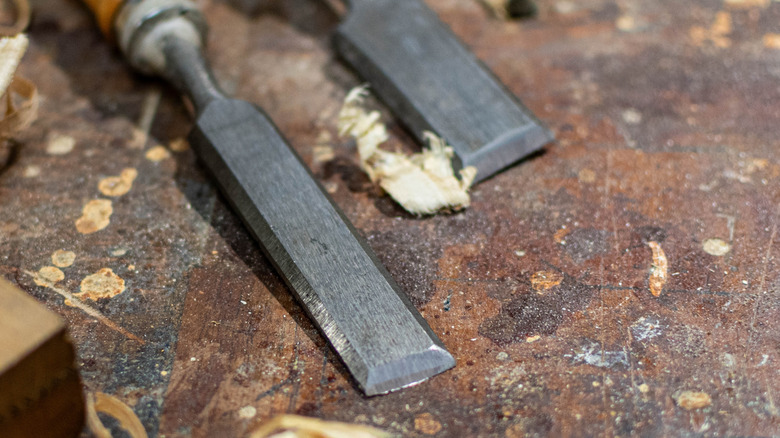
A leftover concrete block — or any concrete block — has more uses than you might think. Because of its abrasive surface, it can also sharpen certain blades when you're in a pinch and don't have a whetstone available. With the right technique, wet concrete can remove dull metal and recreate a usable cutting edge.
The method will work most naturally on a flat, straight blade whose existing bevel can sit evenly against the block. Think of a plane iron or a chisel. The bevel is the angled strip of metal that makes up the cutting edge. The process of sharpening removes material from this area until its two surfaces meet in a fine point, creating the blade. Because concrete is harder than the steel being hardened in this circumstance, it can perform that job. But different concrete blocks will cut at different speeds and leave different scratch patterns, so the finished edge may therefore end up rougher than one produced with a graded sharpening stone.
You should avoid using this method on really valuable knives or blades with curved, serrated, or unusually shaped edges. Those designs will need sharpening tools that match their profiles; serrated knives will need a tapered sharpening rod, while mower blades must be sharpened evenly and balanced before being reinstalled. You also shouldn't try this method with cracked, bent, or deeply chipped blades; they should be repaired professionally or replaced rather than rubbed against concrete.
How to sharpen sturdy garden blades with a concrete block
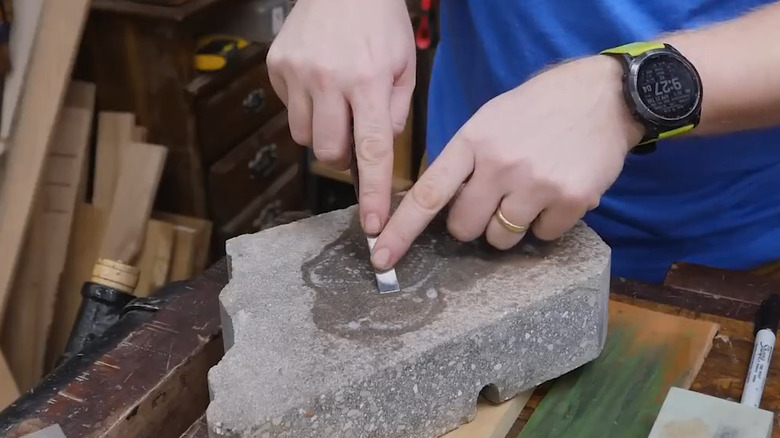
Choose a block with a flat, smooth face. Don't use painted, sealed, cracked, or extremely rough surfaces. Place the block on stable ground and wet it with clean water using a trigger spray bottle. The water will mix with the loosened concrete and metal particles, which will create a slurry that assists with grinding.
Afterward, clean the blade and inspect it. If its angle is difficult to see, color the bevel with a permanent marker. This clever trick for sharpening blades makes it easier to preserve a blade's existing bevel, because any remaining ink shows where the metal has not contacted the concrete. Now place the bevel against the wet block. Move the blade smoothly across the surface using light pressure, ensuring the bevel is the part in contact with the concrete. Stop frequently to ensure the marks are appearing evenly along the cutting edge. Continue until you can feel a slight lip of excess metal on the opposite side.
Apply honing compound to a firm leather strop, then pull the blade backward across it with the cutting edge trailing. Don't push the cutting edge forward or apply much pressure, as it could dig into the leather. Alternate between the bevel and the back of the blade until the burr disappears and you're left with a smooth edge. Clean and dry the blade and test it on paper or, if it's a woodworking blade, a piece of scrap wood. Remember, this is an improvised solution; if you're struggling with dull blades, a purpose-made whetstone offers more control for regular sharpening.