

What Does The Little Slider On Your Refrigerator's Crisper Drawer Actually Do?
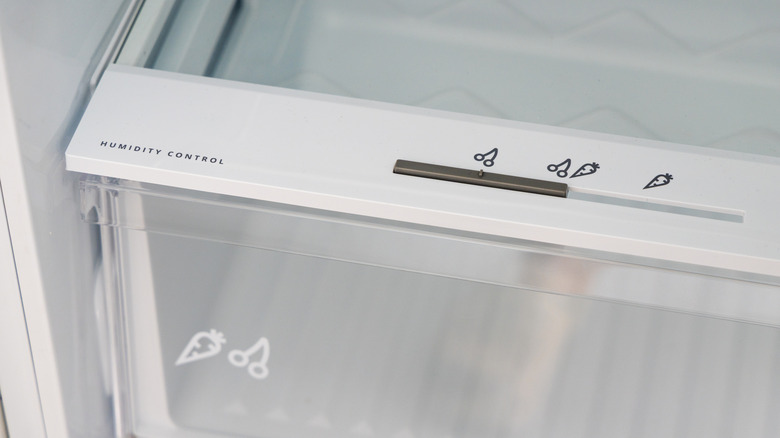
Have you ever looked at the slider on your refrigerator's crisper drawer and wondered what, exactly, it's there for? While your crisper drawer is designed to keep fruits and veggies fresh, it's that little slider that makes the drawer work so well. And for maximum effectiveness, you should know how to set it. The slider is designed to allow you to set the proper humidity level for storing fruits and vegetables in the crisper. At its lowest humidity setting, the drawer's vents open, allowing air to escape and effectively reducing the humidity within the drawer. Move the slider to the highest setting, and the drawer's vents will close, trapping humidity inside. Any time you place produce inside your refrigerator's crisper drawer, it produces its own humidity. If you let the humidity escape, the produce inside will stay dry. Trap the humidity, and you can keep fresh and delicate produce from wilting.
The lowest humidity setting is best used for most fruits, to keep them from molding or rotting; fruits release ethylene gas as they ripen, which is also what causes them to rot over time. Allowing that gas to escape through the vents of your crisper can help keep your fruit fresh. Meanwhile, higher humidity settings should be used for things like fresh greens, such as herbs or spinach; the water in the air helps keep their leaves plump and juicy, rather than dry and wilted. If you're lucky, you might find that drawer's slider is labeled with small illustrations of fruits and vegetables to show you exactly where the slider should go for each type of produce. If your fridge lacks labels, here's what you should know.
How to use your refrigerator's crisper drawer properly
Most fridges will come with two crisper drawers, so that you can designate one for low-humidity items and the other for high-humidity produce. If yours only has one, you should generally use it on its high-humidity setting. Fruits that require low humidity can often be kept on the counter or in the pantry instead — try this stylish countertop fruit storage DIY if you're looking for a good spot to put them.
Low-humidity produce typically includes fruits like avocados, apples, pears, peaches, citrus, berries, and other stone fruits. Meanwhile, spinach, kale, and lettuce all belong in your high-humidity crisper drawer. Other vegetables that are full of water and wilt easily include cucumbers, eggplants, peppers, and carrots; keep these in a crisper that's set to high humidity. Generally, vegetables are more likely to want high humidity, while fruit is more likely to need low humidity.
Are you wondering what it means if you have a crisper drawer without a slider? Chances are your crisper drawer is naturally set to retain high humidity; its vents stay closed all the time rather than sliding open or shut. You can test that theory by simply placing a piece of lettuce inside and seeing if it wilts after a few days. (Just be sure that you're not confusing your fresh drawer with your crisper drawer!)