

Turn Ordinary River Rocks Into High-End Bowls With An Impressive DIY
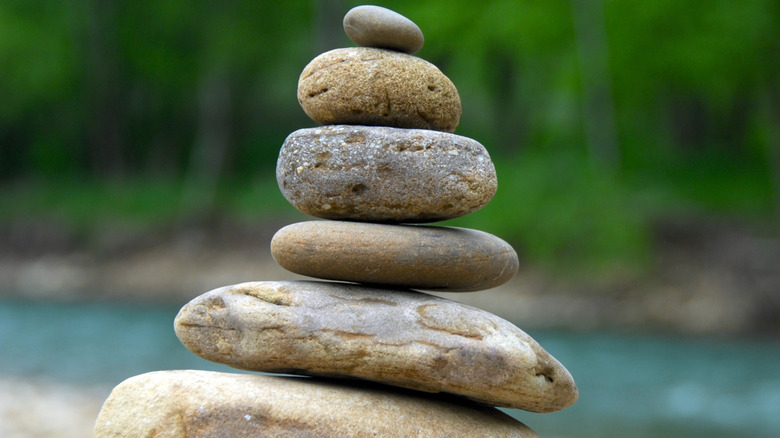
The urge to eat fancy things out of unexpected things must be a thing, since it happens all the time. People buy expensive meals at restaurants every day and eat them off of slate tiles, iPads, VHS tapes, snowboards, or the back of a hand, washed down with something sipped from a lightbulb. Today our question is: Have you ever felt the urge to eat wilted arugula with mirin and, say, Panko, off of the key bowl from your entryway drop zone? If so, architect and designer Ben Uyeda has just the DIY project for you.
Uyeda's TikTok video titled "I [am] carving rocks into bowls using my @RYOBI Tools USA angle grinder" shows him doing just that: converting large, smooth river rocks into fancy bowls for a restaurant project and possibly a little product placement. Joking aside, it's a very cool idea, and the finished product is a shortcut to some high-end-looking bowls at very little cost. Sure, you could simply turn an ordinary glass bowl into faux-stone decor. But bowls like Uyeda's retail for anywhere between $8.99 and $2,800, depending on size, craftsmanship, and the gullibility of the purchaser — we'll explain later why you might not want to eat out of an $8.99 rock. The mechanics of making a river rock bowl aren't that complicated if you have the right tools. Uyeda uses an angle grinder with a diamond tile-cutting blade. Possibly the most brilliant thing about the whole enterprise is the sandbox he uses to "clamp" the smooth stone in place while he works on it.
How to carve a river rock bowl
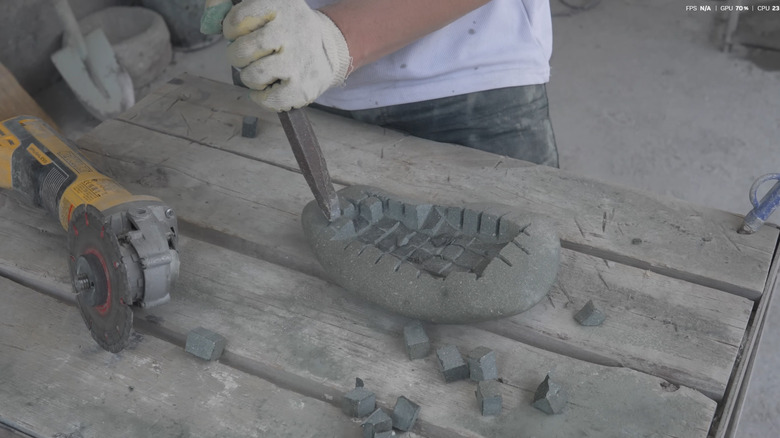
It's probably a good idea, as Uyeda suggests, to flatten the bottom of the stone so you don't later end up with wilted arugula in your lap. One doesn't want to play hockey with a big rock and a 10,000 RPM grinder. For smaller bowls, suitable for a teaspoon of human honey ice cream or a blade of spartina in cream sauce, he makes cuts in a radial pattern — sort of like an asterisk or Kurt Vonnegut's signature on Adderall. Uyeda then breaks the stone out with a hammer and chisel, forming a rough depression. "Origami sort of flower-shaped depression" is the phrase that really got his commenters engaged.
@benuyeda I an carving rocks into bowls using my @RYOBI Tools USA angle grinder and a diamond tile blade. These are for the restaurant at the hotel i am building. #rocks #stone
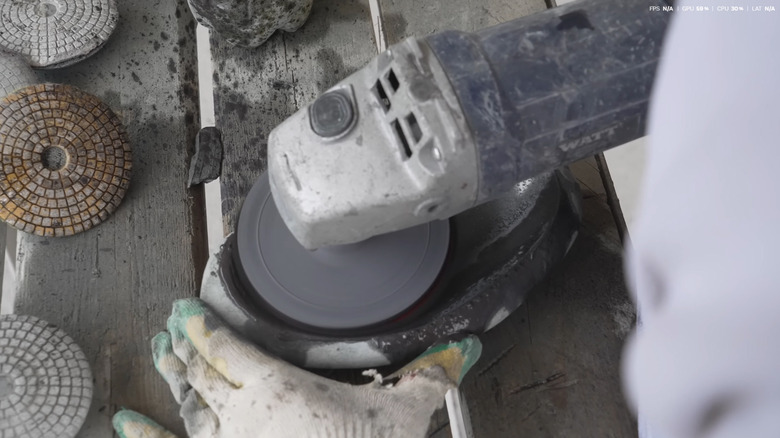
After that comes grinding the depression smooth with the tile blade; he does mention other options like a diamond ball grinder with an extension shaft, which is a carving tool offered by many retailers but perhaps only ever bought by Ben Uyeda. For a larger bowl, rough out the stone by cutting a grid to the size of a bigger, oblong depression.
Of course, you're not stuck with just food bowls. Artisans like Vladislav Savchenko use variations on this method to make everything from bathtubs to sinks, plates, and coffee mugs, as well as vases, candle holders, soap dishes, and various sculptures.
Safety issues with river rock food containers
Uyeda mentions the need to send off samples of your rock for lab testing and to use a food-safe finish. This is serious business, because the very shape of porous river rocks makes them difficult to sanitize or decontaminate, and rivers aren't always known for their cleanliness. You could, of course, delve into mineralogy and learn things like avoiding many minerals ending in -ite like malachite, pyrite, fluorite, alexandrite, and amazonite. You might discover that sulfide-containing minerals like pyrite, in water, can liberate heavy metals like arsenic, copper, lead, and zinc from bedrock, suggesting that bedrock, at least, contains arsenic, copper, lead, and zinc. But that seems rather a long way to go, and since heavy metal contamination is often a byproduct of human activity, not stone erosion, testing might be a better approach than expertise.
Testing for every possible naturally occurring toxin and chemical pollutant might be impractical for an $8.99 bowl, so thoroughly sealing your river rock bowl seems a good idea. The food-safe sealants necessary for dealing with porous rock can be expensive; a pint of MORE Stone Sealer costs $55.63 at Walmart, for example, which might create some economy-of-scale issues. But who, besides Ben Uyeda, says you have to use your stone bowl for food? There are a thousand things you could keep in a nice-looking bowl like that. Your keys, for example.