

Say Goodbye To Carpenter Bees With The Help Of WD-40
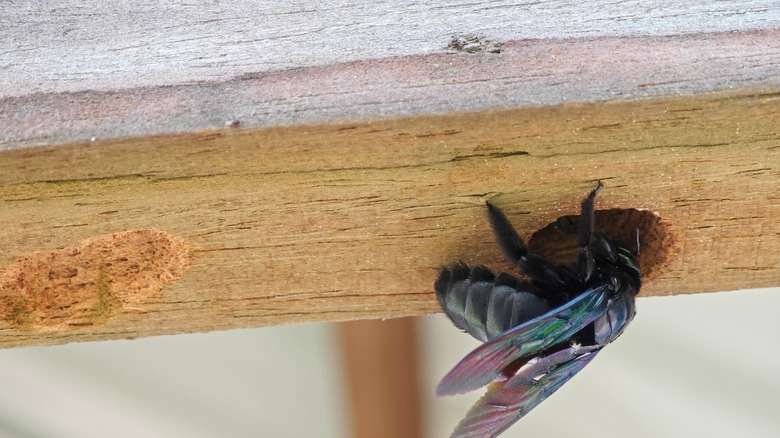
Carpenter bees have developed an effective survival technique that ensures they have a home anywhere trees are growing. They simply bore 1/2-inch holes into the wood, and once they've made a deep tunnel, they have a safe place to rear their young. People would be more likely to sit back and marvel at this feat of evolutionary adaptation if the bees were more discriminating and didn't choose human-made wooden structures instead of trees. Unfortunately, they do, and the damage they inflict prompts people to eradicate them instead of appreciate them.
If you're one of those people, and you don't have any insecticide handy, you may be wondering if spraying the bees with WD-40 will kill them. If you believe the live demonstrations from YouTube users motofun and PineyGroveHomestead, the answer is yes. In these videos, the people who posted them sprayed the solution into the hole in which there was a live bee, and the bee emerged shortly thereafter, and died. So there you have it: Kill carpenter bees by spraying WD-40 in their holes.
In both videos, the bee was saturated with the spray when it emerged, which begs the question: Will WD-40 kill bees that don't come into direct contact with it, and will the spray residue prevent bees from returning? In short, does WD-40 actually repel carpenter bees?
Using WD-40 as an insecticide

There's little evidence that WD-40 can be used as an insecticide. After all, WD-40 is for dissolving rust and freeing stuck metal parts. However, anecdotal evidence — like the YouTube videos mentioned — demonstrates that it kills the bees on contact, and this is likely due to the petroleum-based oils it contains. There has been research on the effect on insects of direct contact with petroleum-based oils, and it concluded that death does indeed occur — not by oxygen depletion, but by a range of cellular disruptions.
Will WD-40 keep carpenter bees away if you spray it into their holes? There isn't much evidence one way or another. You can conduct your own experiment at home and upload the results on YouTube, and you'll be adding to the general knowledge base. However, until you (or someone else) demonstrates conclusively that it works, you're probably better off using an insecticide that's proven to work.
Even powerful insecticides, however, will keep carpenter bees out of their holes only temporarily — at most, only three or four weeks. If you want to be done with your bee problem for good, the proven way to deter them is to fill the holes with a hard material, like a two-part wood filler, after making sure the bees are gone. Otherwise, they will drill new holes to get out. Painting bare wood is also an effective way to discourage carpenter bees from drilling holes in wood.