

Thinking Of An Induction Stovetop? The Big Downside You Should Know First

You're upgrading your kitchen, and you've decided an induction stovetop is worth the splurge. But do you really know what you're getting into? Despite the advantages, like consistent heat, energy efficiency, and faster cooking, there are still some drawbacks to consider. One of the biggest limitations is that you need specific types of cookware that work with the induction cooking process.
So, what's the deal with needing special cookware? It has to do with how this type of cooktop generates heat, which is through electromagnetic energy. Copper coils underneath the smooth top create a magnetic field that heats the pan but not the glass stovetop itself. But for the magnetic field to create an electrical current in it, thereby heating it, the cookware material needs to be ferromagnetic. In other words, one of the key downsides to induction stovetops is that you need pots and pans with magnetic material within their construction so they can interact with the magnetic field generated by the stove.
If your current cookware isn't induction-compatible, you'll have to buy a new set of pans on top of the cost of your new cooktop. Metal adapter discs are available for relatively cheap and allow you to use non-ferromagnetic cookware on your induction burners, but they're often only a temporary solution. Unfortunately, adapters eliminate the rapid heating and many other benefits that make these cooktops so appealing in the first place. You could expect to spend at least $1,000 on an induction cooktop, but more advanced styles and luxury brand models can cost several thousand dollars. Before you make that investment, find out if you need to buy new cookware at the same time to enjoy all the perks that induction cooktops advertise.
Induction stovetops require special cookware
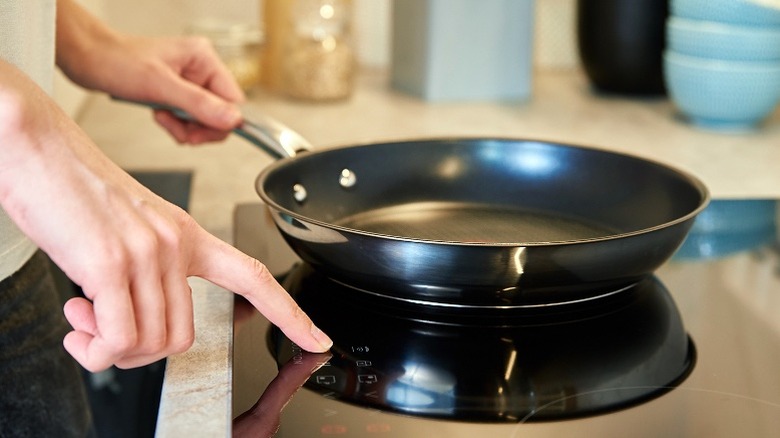
Whether you get a traditional glass-top style or a futuristic invisible induction cooktop, the cookware limitations are the same. The types of pans that work with induction include enameled steel, cast iron, carbon steel, magnetic stainless steel, and nonstick pans made with induction-friendly magnetic bases. It won't work with an all-aluminum, copper, glass, ceramic, or stainless steel pans without magnetic bases. New pan sets should indicate on the packaging that the cookware will work with an induction cooktop. You can also check your pans for a coil symbol that means it works for induction cooking.
Now, before you run out and buy new cookware, your current pans may already be induction-compatible. The base of the pan is what matters — it needs to be made of a magnetic material and have a flat bottom for even and complete heat distribution. Test your existing pans by putting a magnet on the bases to see if it sticks. If it does, you know you have a magnetic pan that should interact with the electromagnetic field of the cooktop. If it doesn't, prepare to shop for new induction-compatible pans. And, of course, you can always try out your pan on your new stove; if it doesn't heat up, it's likely not compatible.
The size of the pan also matters. It needs to roughly match the size of the burner, because it might not trigger the heating process if it's too small. And if the pan overhangs the burner, you'll miss out on the even, consistent heating that induction cooktops are known for. Some models incorporate a pan detection feature, which senses the size of your pan and targets the magnetic field to that area.