

Not Fencing: How To Use Concrete Blocks To Add Privacy To A Yard Without Blocking A Breeze
We may receive a commission on purchases made from links.
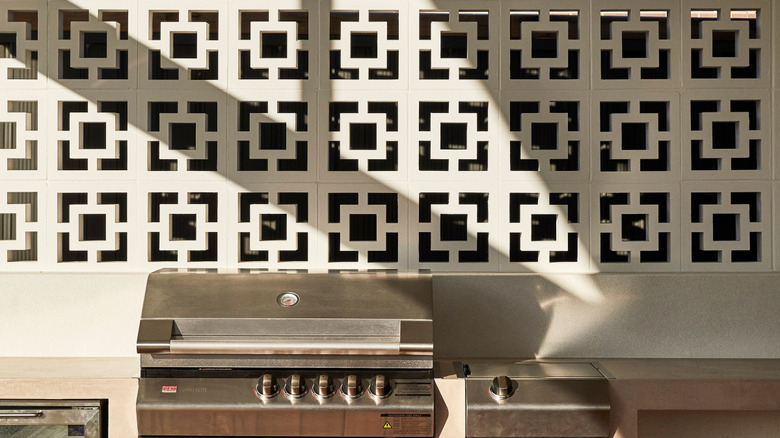
Fencing is one of the most popular ways to create backyard privacy, but it can black airflow and result in smaller patios feeling hot and stuff. There are, however, alternatives to traditional fencing. One way to create a sense of privacy and seclusion in your backyard is to use breeze blocks. While they look like a solid wall from a distance, the cutouts in these concrete blocks allow both air and light to pass through, allowing light and air to pass through while screening your yard from your neighbors' view. They are also highly decorative and come in a wide variety of styles to match the aesthetic of your home.
Breeze blocks are far from a new invention. A similar idea appeared centuries ago in Asia, where people used pierced or woven screens outdoors to create shade while still allowing air to pass through the screen. The concrete version was popularized in the U.S. in the 1930s as part of the Art Deco movement, though Frank Lloyd Wright had been experimenting with patterned "textile blocks" since the 1920s. Breeze blocks hit their peak during the mid-century modern craze of the '50s and '60s, when they became an important stylistic architectural feature, as well as a practical one. They were especially popular in hot regions, facilitating airflow rather than trapping heat, but equally useful as a windbreak in areas that require extra shelter for outdoor spaces.
Styling your breeze blocks
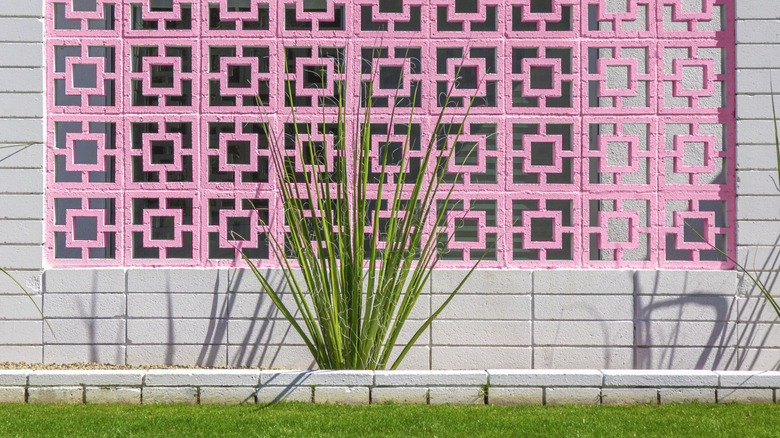
If you're looking for decorative breeze blocks, masonry and landscape suppliers are your best bet. This gray Orco Breeze Block in a square-on-square pattern from Southwest Boulder & Stone, for example, is available in multiple sizes and styles. However, if patterned blocks are a bit outside of your budget, standard 8-by-8-by-16-inch concrete blocks from Home Depot are a less expensive alternative, and you can arrange them with intentional gaps for a sleek, geometric pattern that still lets air and light through. Just ensure these blocks have hollow cores before you buy.
There are lots of different visual effects you can achieve with your breeze block wall, depending on what style of block you choose and how you install it. While breeze blocks are architecturally synonymous with mid-century modern design, there are plenty of ways to give them a contemporary feel. You could try painting the concrete blocks to add a pop of color to your patio, or using planters and climbing vines to create a vertical garden wall. Either of these approaches will soften the appearance of the concrete and reduce the overall mid-century modern vibe. You can also opt to use breeze blocks as an insert into a larger patio wall rather than as a wall themselves, or as a partial dividing wall, achieving the same degree of privacy as traditional fencing, without blocking that refreshing breeze that makes outdoor living so appealing.