

Farewell To Pricey Aerators: 4 Home Depot Finds For Under $50
We may receive a commission on purchases made from links.
We're a little obsessed with our lawns, understandably. A green lawn somehow signals our full participation in society, and full participation ain't easy. Walking 100 miles every year to mow it is bad enough, but aeration is a whole other level. You walk a few dozen more miles, pushing a 300-pound drum designed to do nothing so much as get perpetually stuck, and you have to pony up hundreds, or thousands, of dollars for the honor. If you're stuck with a grass farm and the stern gaze of neighbors, we found four plug and spike aerators in various guises that help you with aeration for less than $50 each. You still have to walk 8 miles and poke 80,000 holes, but at least you can afford fertilizer, grass seed, and an epic water bill.
However, before you dive in to the list or to aerating, consider that you might not actually need to aerate. The point of aeration is to mitigate soil compaction. If yours isn't yet severe, you can probably take care of things with good, simple habits, such as watering, mowing, and fertilizing properly. Unneeded aeration can do more harm than good because mechanical aeration has a bad habit of actually worsening compaction while also stressing your turfgrass. Some experts suggest that aeration isn't necessary in 95% of cases. Fortunately, you can tell if it's time to aerate your lawn with a simple screwdriver test.
Manual core aerator: Corona Max YardBreather
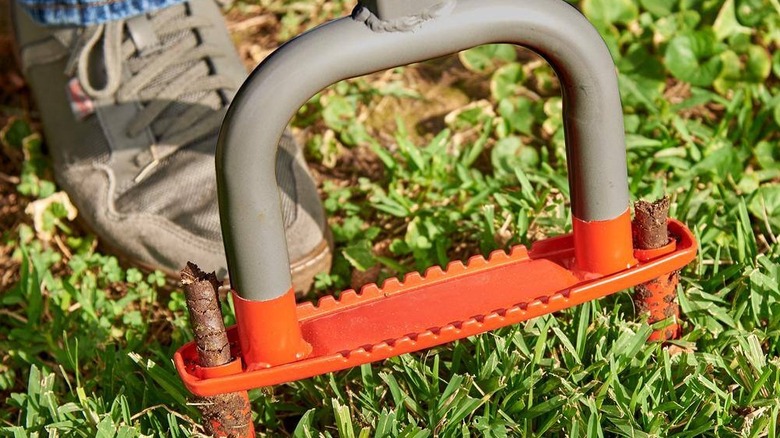
Another important thing to know about aeration is that spike aerators are very nearly useless, often even counterproductive (we'll come back to that). Far preferable is the core aerator, which removes plugs of soil with minimal new compaction, giving water and nutrients a pathway to get to roots which now have a bit more room to grow.
Home Depot sells a manual core aerator, the Corona Max YardBreather, for $32.98. It removes and automatically ejects 3.5-inch plugs of soil using two steel tines driven into your lawn via good ol' foot power. Traction-enhancing grooves on its footplate make this easier than it sounds. Unfortunately, having only two tines makes things a little more time-consuming than necessary, but Home Depot options with more than two tines — such as the $102.75 Misopily Three-Tine Coring Tool – are over our price limit.
The YardBreather gets reasonably good reviews in spite of its paucity of tines. With 4 stars on 780 ratings and 65% of reviewers recommending it, it doesn't wow everyone, but it's functional and affordable. Many reviewers say it's well-made, though some point to weld quality problems that might contribute to certain tines' habit of getting clogged with soil. We recommend examining before you buy (they're in stock at our local store) to make sure both auto-eject tines seem free of obstructions and have quality welds.
Spike aerator: Work-Mate Spike Aerator
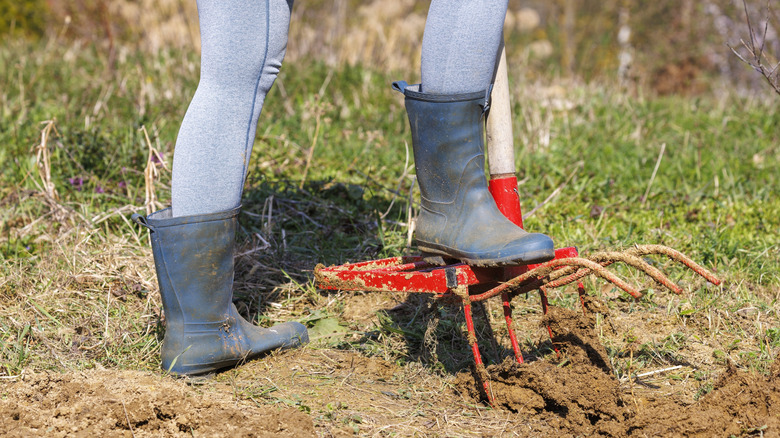
As mentioned, spike aerators aren't always ideal. They accomplish relatively little other than increasing soil compaction at every hole they make, and the small holes close up quickly with time or any amount of foot traffic. One notable exception to this rule is an aeration tool that, unlike power aerators, doesn't damage soil: the time-honored broadfork, usually a sort of sturdy frame with a handful of tines at the bottom.
These tines don't remove soil cores, but do something even better: After they're driven into the soil, pulling back on the broadfork basically fractures the soil, loosening it for nutrient access and aeration, doing most of the work of tilling without any of the negative side-effects. Not that they're mutually exclusive; using a broadfork after roto-tilling is a good way to mitigate the hardpan problem tilling creates.
The Work-Mate Spike Aerator ($24.76) is Home Depot's best option for a broadfork under $50. The top-rated Ames Steel Spike Aerator ($29.97) only has 3-inch tines, while the Work-Mate boasts four 6-inch spikes. These are mounted to a 9-inch-wide head, which is in turn attached to a long handle for great leverage. The Work-Mate only has three reviews, all 5-star, and they point out that the broadfork is lightweight and, according to one wry reviewer, "Pokes holes in the ground as designed."
Push aerator: Corona Max DiscCultivator
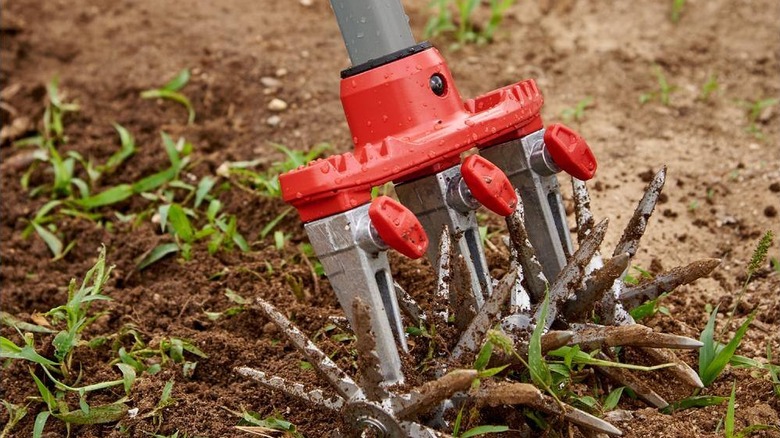
Since so many aeration tools are expensive, useless, or both, it can be sensible to look a little outside the box. The Corona Max DiscCultivator can weed, aerate, and till, and as a tool with multiple uses, it has broader potential than the average single-purpose aerator. At a mere $37.98, it's not hard to see that as a good deal. Its flexibility comes from its three tine wheels that are configurable to help with tight spaces.
The angled orientation of the discs and their small, 3-inch tines make them particularly well-suited for breaking up the surface of topsoil. The loosening action can be a thorough, desirable mixing (as when prepping a spot for leveling), but it's likely to damage existing turfgrass. As an aerator, or anything else, the DiscCultivator is most suited to bare ground, or bare spots in a lawn before reseeding, because reviewers point out that the short tines don't penetrate soil beneath any substantial amount of grass or weeds. Still, reviewers like the DiscCultivator overall, awarding it 4.3 stars on 766 ratings and recommending it 85% of the time. However, we do think the DiscCultivator would benefit from wheels, like the ones found on the Brinly and Suchtale 18-inch push spike aerators.
Thatch rake: Groundskeeper II rake
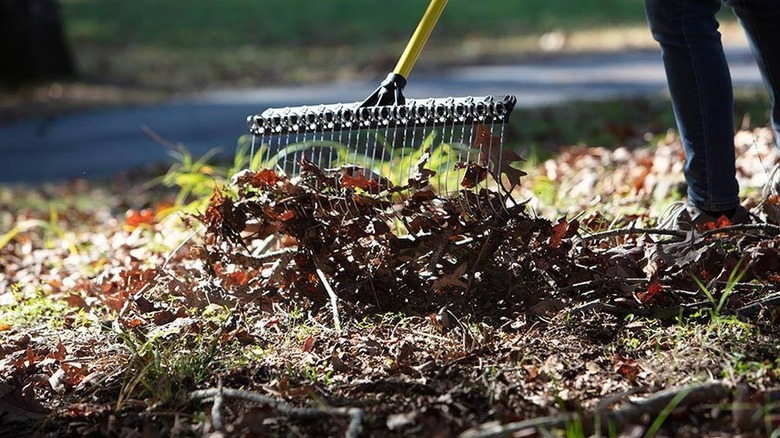
If your soil isn't compacted, you don't need mechanical aeration. But, if you can break up a thatch layer that's ½ inch or thicker, the effect is increased aeration. One good approach is to rake the area to remove thatch, then top-dress with ¼ inch of compost. To that end, we present the Groundskeeper II steel rake ($41.52), a 55-inch, fiberglass-handled favorite of Home Depot customers.
The Groundskeeper II gets 4.7 stars on 465 ratings, with 95% of purchasers recommending it. Reviewers say it doesn't damage grass, and that thatch is easily ejected from the rake's tines. Most users find its dethatching capabilities to be excellent, though a few claim its skill tops out at modest. One reviewer, Arthur, says it "definitely works, but it's a workout to use."
While the Groundskeeper II was designed as a dethatching and general-purpose rake, there are plenty of dedicated dethatching rakes out there, but they're mostly well above our $50 limit. One exception is the $32 Skonyon Aluminum Dethatching Rake, a 20-inch-wide rake with a long handle, 19 curved tines, and an adjustable raking angle. Unfortunately, it has no ratings on the Home Depot website. There are also dethatching rakes for walk-behind mowers, and even other options, such as liquid aerators, which leads us to our selection criteria.
How we chose inexpensive aeration tools
We examined every aeration-related tool on the Home Depot website with a price tag of less than $50, reading and comparing reviews. We gave a slight preference to products in stock at one of our six closest Home Depot locations, and a strong preference to products that could be shipped to arrive within a week over those that would take longer. Where possible, we verified ratings by comparing them with Amazon ratings for the same products.
One category we struggled with was the emerging line of liquid aerators. Some reviewers and influencers swear by them, but others question their efficacy and claim that they're unproven at best. Until more evidence is in, we replaced that category with dethatching rakes, which might not be as easy, but certainly work, and can definitely improve aeration for your turfgrass.