

Skip Power Aerators: There's A Tool That Won't Damage Soil
We may receive a commission on purchases made from links.
Broadforks inhabit an unusual space in gardening in which something that sounds too good to be true is, nonetheless, true. These tools — long, straight-ish tines in line with two long handles — often look like the work of a first-year engineering student who will soon become an English major. But that simple form hides functionality that makes the broadfork a great DIY alternative to pricey aerators, especially powered aerators and tillers that can damage your soil.
Aeration is a means — usually mechanical — of introducing space into a soil structure in which air, water, nutrients, and plant roots can move more freely, and it's usually a reaction to soil compaction. That compaction might be natural, a result of certain soil types and certain environmental conditions, or it might be caused by overuse and by over-working the soil using the wrong methods. Those methods can, ironically, include aeration ... especially aeration that involves spike rather than core aeration tines, and aeration that involves heavy power equipment, particularly on wet ground.
At first glance, a broadfork — basically four or more long tines with two handles — looks like a spike aeration tool. But in action, broadforks show their strengths and differences. To use one for aeration, you simply push the tines vertically into the ground, stepping on the crossbar if necessary. Then the magic happens ... you pull back on the handles, leveraging your body to break the soil free along its weakest gaps and fault lines, which happens both parallel to the tines and laterally, creating a great deal of room for roots and nutrients to move.
Broadforking is not quite spike aeration, and is not tilling
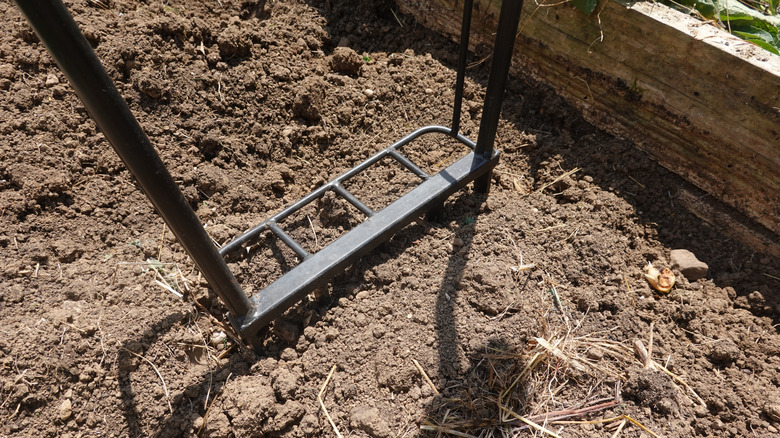
So, while a broadfork looks like a spike aeration tool, it is far better. Spike aeration tends to further compact soil, but broadforking opens the soil along the tines and in other areas, lessening compaction. Unlike heavy power aerators, a broadfork can seamlessly be carried into a greenhouse, but like power aerators, they are powerful enough to aerate your soil. Because a broadfork can aerate without actually turning the soil, it can be far less destructive than tilling.
Most gardeners agree that excessive tilling creates hardpan, a dense, hard layer of soil just below the topsoil that resists water ingress, causing lower rates of seed sprouting, less root penetration by established plants, and reduced nutrient and water uptake. Many also concur that tillers destroy earthworms, microbes, and soil structure, ultimately reducing the nutrients available to plants. As a result, growers tend to fall back on chemical fertilizers, which can further inhibit the growth and work of earthworms and microbes. A broadfork can be used to turn the soil with little risk of creating hardpan outside of wet soil, and by most accounts, it tends to improve both soil structure and the lot of beneficial earthworms, microbes, and fungi.
More uses and benefits of broadforks
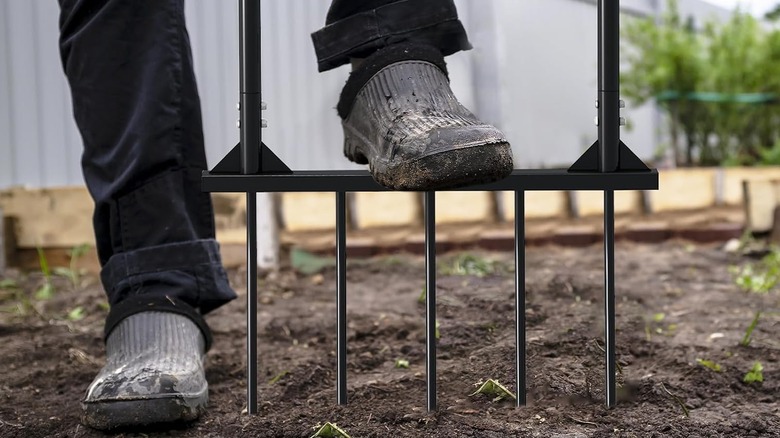
Given the various uses and benefits of the broadfork, it's clearly a worthy addition to any list of recommended DIY landscaping tools, and the go-to for soil-quality-conscious gardeners wanting to optimize time and effort. In addition to deep aeration, a broadfork can be used after roto-tilling to minimize the hardpan effect. Commercial broadforks with particularly strong all-steel tines — thick, often curved spikes that look like the teeth on a tractor implement — can be used to remove sod and even to break ground that hasn't been worked before.
Broadforks not only bring all the benefits of aeration — reduced erosion and healthier plants with access to air, water, and nutrients — they also help to reduce standing water in low areas and assist in loosening and exposing weed roots for removal. In taking better care of earthworms, they also enable the sort of long-term tillage and fertilization the worms can provide. Together, all of this means a better lawn or garden, and, if it's your thing, better harvests. Speaking of which, the broadfork makes a great replacement for a garden fork at harvest time when you're growing potatoes.
Ultimately, broadforks are a means of creating deeply penetrable soil in a relatively short time. Additionally, you might eventually find that you no longer need it for aerating a particular patch of soil, and you'll be glad you have it for the next one.