

Stronger Than Concrete Blocks: The Natural Stone That Makes A Beautiful Retaining Wall
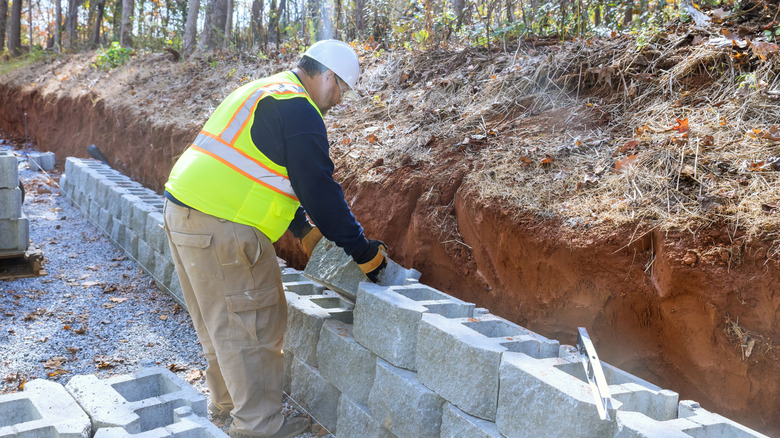
Undoubtedly, soaring concrete costs are changing how people landscape their yards. Still, you may feel compelled to rely on concrete blocks when building a new retaining wall in your yard, as they're incredibly strong and durable. In case you're in a similar situation, know that there's a natural stone that can give concrete a run for its money. In an exclusive interview with Hunker, Brad Holley, Design Director at Outdoor Dynamics, champions natural limestone. Sharing the primary reason behind this endorsement, he said, "Natural products, like stone, are so much more interesting because each and every single piece that you source is going to be unique ... And I think this is one of the things that draws people toward the idea of building natural limestone retaining walls."
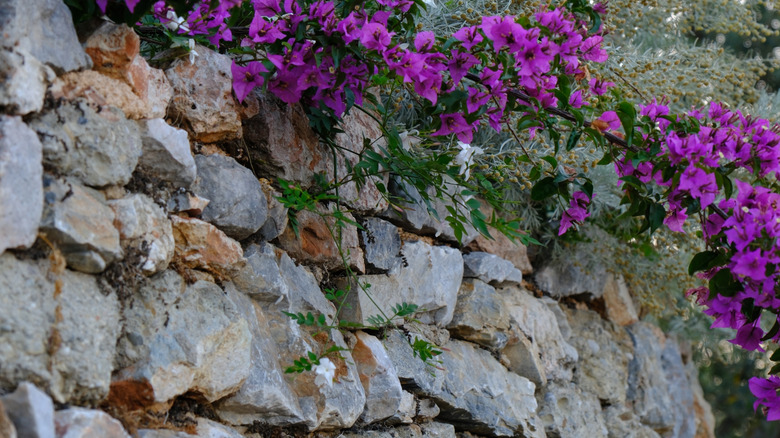
Holley explained that each block, regardless of its size, is cut from quarried stone before it's transported to the job site. Moreover, a mason might further chisel or cut it to fit better, making it even more unique. "It's this incredible mixture of natural beauty and hand-sculpted art," noted Holley. He also said that natural limestone's weight is an advantage, since a retaining wall must stand strong against the lateral forces of soil. "Compared to a CMU (concrete masonry unit) block, a natural limestone block of the same size is going to be heavier. And weight can lend itself to strength and reliability," he elaborated. Plus, limestone blocks are extremely tough and stand up well to harsh weather. Praising it, Holley added, "Limestone is a very dense material; some varieties even more so than others. Whether we're talking about sunlight and heat, rain, hail, and even ice, limestone can take nature's heaviest beating."
When should you opt for a natural limestone retaining wall
Still on the fence about ditching concrete blocks for natural limestone? Brad Holley told Hunker that limestone's solid, dense composition generally makes it stronger and more durable. "CMU blocks are strong and heavy as well, but they're manufactured to intentionally have large voids in the middle," he added. And this can be a double-edged sword. These voids can make for a stronger wall when the right construction techniques are used. However, since that isn't a given in every scenario, Holley explained that "the block itself, coupled with the way a CMU block is typically assembled, can lend itself to creating a slightly weaker or more fragile wall when compared to a limestone block." Given this, he feels a CMU block is more likely to develop cracks when it's subjected to extreme temperatures and repeated cycles of expansion and contraction.
Aesthetics are another reason homeowners opt for limestone over CMU blocks. "Either material can and will result in a strong, long-lasting retaining wall. But CMU, by itself, is not an appealing finish," Holley said. So you can't call it a day after you build your wall. If you don't like the look of exposed CMU, you'll have to clad it with tile, stone, or stucco to make it more palatable — something you won't have to do with limestone. "Limestone is almost always chosen for its rugged beauty and naturally rustic aesthetic," Holley noted. It's especially ideal if you want a modern retaining wall with a clean finish. You don't have to stop there, either. Feature it throughout your yard since it also makes for a gorgeous patio option that won't scorch your bare feet.
How does a limestone retaining wall compare to concrete in terms of costs
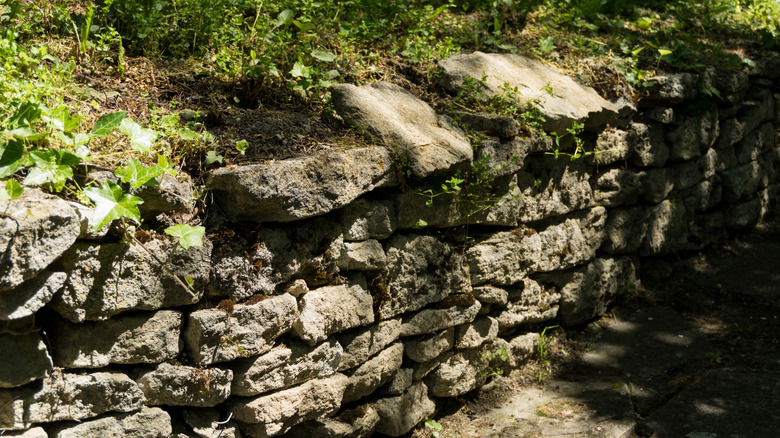
On pricing, Brad Holley explained that upfront costs for a limestone retaining wall are higher than for concrete blocks. "If you live in a state or area that is far away from limestone quarries and sources, the cost of acquiring it will naturally be higher for you because it's a very heavy material and shipping costs are strongly correlated with weight and distance," he said. Costs may be lower if you live in a region where limestone is abundant, such as Dallas, where Holley is based, but the overall pocket pinch will still depend on the kind of retaining wall you have in mind. Most of the time, Holley said you'll pay more upfront for natural limestone.
The upside, according to Holley, is that a finished wall requires almost no maintenance spending to keep it standing for decades. "If time causes the wall to shift (and that's a big if), then the blocks shift accordingly, but they'll still be standing," he detailed. That's not usually the case with a CMU block wall. Because of this, you'll need to consider the cladding you use and how it will shift over time, along with the kind of bonding agents and adhesives you choose. Holley added, "If good mortars or epoxies and grouts aren't used (or applied poorly), materials can detach from the wall. Stone and tile can crack, chip, or fall off. Even stucco and paint can fade or delaminate over time." For that reason, Holley argues that limestone can be more cost-effective in the long run despite its higher upfront price.