

Why Your Bench Grinder Turns Tool Edges Blue
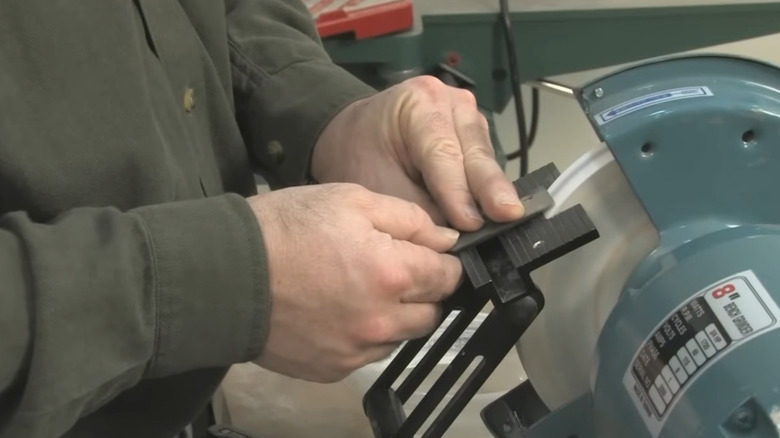
Bench grinders are the bomb-diggity when you need to sharpen something like a knife, chisel, or a lawnmower blade. Sharpening with a bench grinder is a concept that's easy to grasp, too. Grind away sufficient metal to reform the original sharp edge, and you're all set. But a common problem occurs when we are first learning to sharpen with a bench grinder, and the edge overheats and turns blue. That blue (sometimes black) color means that the "temper" of the steel has changed, making it softer and less strong. It's a big problem.
Tempering is a kind of heat treating of steel. Tempered steel has been hardened through a process of heating and quenching. Then, it's heated to a lower temperature and allowed to cool. A very basic way to understand it is that the high temperature makes the steel stronger but brittle, kind of like glass. When it's then heated to a lower temperature and allowed to cool slowly, the structure of the steel changes, leaving it strong, but less brittle. Brittle steel can be sharpened, but it will fracture easily, making it impractical for cutting edges. Tempered steel is both strong enough to be sharpened but will not fracture as easily. The blue "burn" on a cutting edge must be removed, as it will not perform well.
Beating the heat
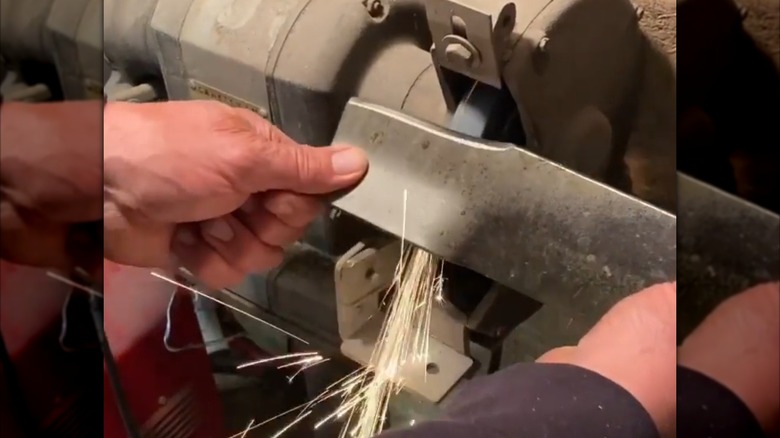
When you are using a bench grinder to sharpen a kitchen knife or anything else, the abrasive quality of the grinding wheel creates heat, a lot of it. In fact, to turn that steel edge blue it needs to get to over about 600 degrees Fahrenheit! So, the trick is to grind the edge but not let it get too hot. This can be done in several ways. The easiest and most practical is to gently hold the edge you are sharpening to the grinding wheel, moving it smoothly across the edge without stopping. After the pass allow the edge to cool. (Many people use water to do the cooling for them). By taking care with each pass over the grinding wheel, you will avoid creating the blue burn.
When a blue burn occurs, it must be removed. (It is a mistake commonly made!) You do that by grinding past the discolored area of the steel. Of course, you need to avoid overheating the blade as you do. Once you get past the damaged steel you will need to re-establish the cutting edge. The best practice is to return it to the same bevel that was originally on the blade before you had to regrind it. One truism that may help you is that a perfect cutting-edge would be infinitely thin and infinitely smooth. All other edges are a compromise of some sort. Keeping the blade cool is the only way to avoid turning the edge blue.