

Why One-Way Window Film Stops Working At Night
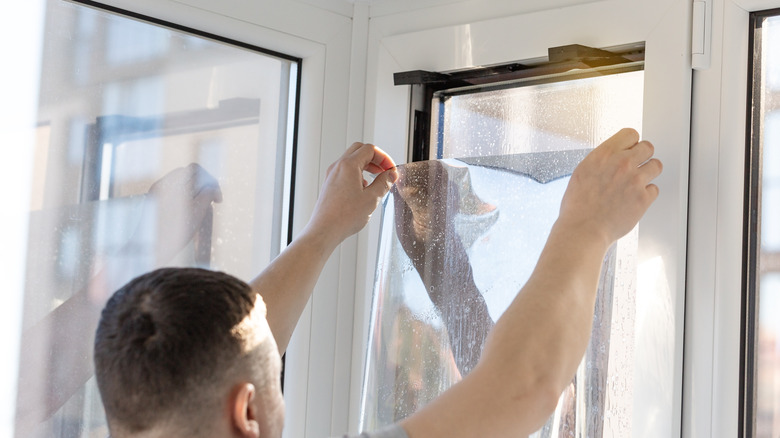
While a one-way window film is a genius curtain alternative to add privacy to your sliding glass doors and regular windows, it's not ideal for every room in your house. Take, for example, a street-facing window in your living room, bedroom, or nursery. You get daylight and a view, while passersby see nothing but their own reflection. Then, the sun goes down, you turn on a lamp, and that privacy disappears. It's a frustrating discovery, but one-way window film is never truly one-way. Actually, it creates privacy during the day by reflecting the light toward whichever side of the glass is brighter, but at night it fails as the effect depends entirely on the light contrast and not on direction.
One-way window film is basically polyethylene terephthalate or PET combined with tiny particles of some metals. This layer doesn't block the light by itself, it just reflects the light off whichever side of the glass is brighter. At night, when the sunlight is absent and if the outdoor ambient lightning is too faint to replicate the effect of sunlight, the glass becomes visually transparent. A true one-way glass that lets light travel in only one direction hasn't physically been created yet. Instead, what you observe from a one-way film is a visual phenomenon.
To boost your privacy at night as well, you'll need to replace the film. If you'd rather not replace your one-way reflective film, install brighter lights outside, such as floodlights aimed at windows, and dim the interior lights. You can also light up your yard using landscape lighting. As for rooms you can't dim, install blinds or black-out curtains.
Get privacy at night with these options
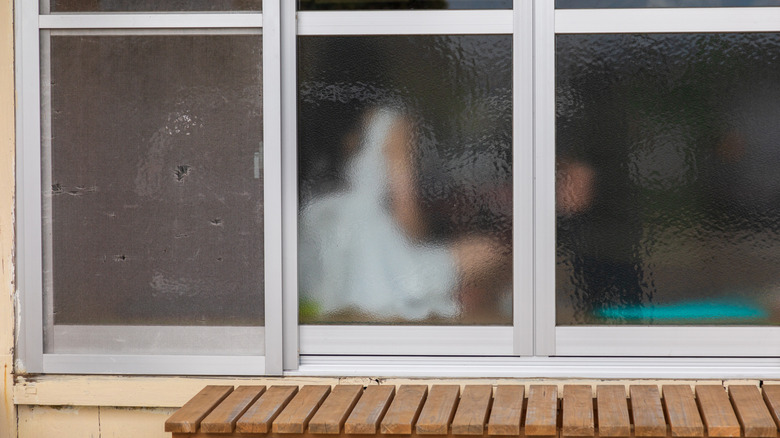
For permanent, round-the-clock privacy, frosted films are a practical alternative to reflective films. Their textured surfaces diffuse light so natural light gets in but nobody can see through. Madico's Frost Matte film, for example, lets through 67% of visible light, which means about ⅔ of daylight still reaches the room. The trade-off is that you give up the view: frosted glass is always frosted, day and night. If you want absolutely no light filtering in, blackout films are the better choice. Johnson's Black Out film has 0% visible light transmission and provides 100% privacy, so no light passes through. During installation, make sure that the film is covering the glass entirely to prevent light leakage. Though blackout film isn't suitable for living rooms or view-oriented spaces, it works well in bedrooms and nurseries.
But what if you want daylight and a view during the day plus privacy at night? That's where Polymer Dispersed Liquid Crystal (PDLC) switchable film comes in. PDLC film, also called smart film, is a brilliant way to add privacy to glass doors without dust-catcher blinds. It's fitted to the glass and connected to a switch, remote, or app that controls the electricity: turn it on and the glass turns clear, turn it off (or if there's no power) and it turns opaque.