

Skip Hardwood Flooring: A More Sustainable, Attractive Alternative

During my time as a flooring installer/refinisher, I worked with many flooring materials, including solid and engineered hardwood, laminates, and tile, and I have a clear favorite. It comes from a species of oak that grows only in countries surrounding the Mediterranean — mostly in Portugal — and it isn't a hardwood. It's cork, which is harvested from the bark of the cork oak tree (Quercus suber).
As a flooring material, cork has it all. It's sustainable, because harvesting the bark doesn't harm the tree, which simply grows more bark. It's hypoallergenic, fire resistant, and thermally and acoustically insulating. It's lightweight, but far from being porous and allowing spills to seep onto the sub floor, it's completely impermeable. You might think a light material like cork would wear out in a short time, but the cork floor I installed in my house is still looking like new after 20 years, and it's in a couple of high-traffic areas, including a bathroom.
The cork that gets used for flooring is what's left over after the top-grade material has been turned into stoppers for wine and olive oil bottles. Manufacturers mix cork granules and larger sections of bark with resin binders, and press them into planks that snap together. The planks are constructed in layers, which makes them comfortable for walking, adds insulation value, and the snap-together design makes them as easy to install as laminate wood flooring. It took me only two days — working by myself — to install 1,200 square feet of cork in my house.
Cork flooring offers design variety and time-tested durability
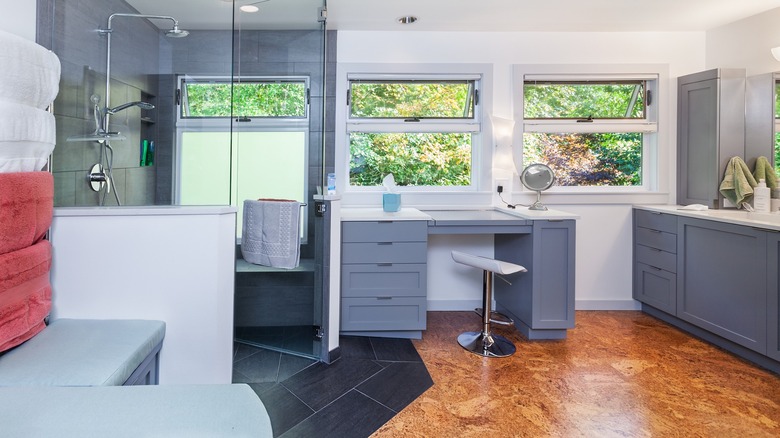
Cork flooring comes in over a hundred colors, including earth tones, primary colors like blue, green, and red, and even black, white, and off-white. Of course, it also comes unstained, with the cork displaying its natural colors. The top layer of a cork plank may be fabricated with large pieces of bark or a slurry of smaller pieces mixed with binders pressed onto a high-density fiberboard core. Large pieces form irregular patterns, and each board constructed this way has a unique appearance. Boards made with smaller pieces have a more regular appearance, and are more likely to be stained.
One reason for the durability of cork flooring is the resilience of the material itself. Cork fabric (yes, there is such a thing) is so resistant to abuse that some manufacturers use it as a substitute for animal leather. Another reason is that most cork flooring comes with a highly impact-resistant urethane coating, and while it won't last forever (no coating does), it's easy to restore. Finally, there's the fact that cork is naturally resistant to rot and pests. It contains a natural wax called suberin that repels moisture and deters insects like termites, ants, and beetles.
The cork floor in our house hasn't even faded after 20 years, much less sustain damage. When it does fade, all it will need is an application of polyurethane to make it shine again — no sanding necessary. That's reason enough for an old flooring guy to love this material.