

If You Want More Tomatoes In September, Don't Skip This One Crucial Task

Waiting for those beautiful tomatoes (Solanum lycopersicum) to turn red is often a lesson in patience. Once mid-July to August hits, it feels like the supply of delicate, sweet fruit will never end. You may even find yourself giving away tomatoes or preserving them for cooler weather. But the production starts to slow as September nears. To hold onto summer a little longer, try one crucial tomato plant care task: topping the plant. Even if you've mastered how to grow tomatoes, this could be a trick you haven't tried yet.
What is topping? It simply means cutting off the main stem of your tomato plant. There are two main reasons to top a plant. One is to limit its growth once it surpasses the top of your support system. The other (and the reason you should do this type of pruning in September) is to redirect the plant's energy into growing and ripening the remaining fruit on its vines. It stops your tomato plant from producing new fruit and instead focus on ripening the ones it already has before it gets too cold.
Not all tomato plants need to be topped, though. It's specifically useful for indeterminate tomato varieties — the ones that will continue growing and setting fruit until the cold weather no longer allows it. Determinate varieties have a much shorter fruiting and harvesting time — they produce a lot of fruit in a short time frame, often one to two months — so they don't need the encouragement to ripen fruit.
When you should top your tomato plants

You can and should top tomatoes when you're growing indeterminate varieties. Not sure what you have? There are ways to tell if your tomato plant is determinate or indeterminate. If your plant is large, sprawling, and producing over a long period, it's probably indeterminate. They might also be referred to as climbing or vining tomato plants. They typically start maturing later than determinate tomatoes but will continue growing and setting fruit until the plants freeze. Common cultivars that are indeterminate and suitable for topping include 'Better Boy,' 'Big Beef,' 'Brandywine,' and 'Juliet.'
Tomatoes are one of the plants to prune in September for a healthier garden. In this case, the type of September pruning you're doing is topping the plant. Ideal timing for topping tomato plants is about six to eight weeks before your area has its first frost of the fall. You can do it as close as four weeks, though. Topping the plant any closer to the first frost likely won't give all the fruit enough time to ripen. That being said, you also don't want to top a plant too early because it cuts down on the total amount of tomatoes you'll get.
Topping tomatoes when it's dry is best — there's a lower chance of causing a disease that would affect the plant's production. You also want to top tomatoes when plants are healthy, and not stressed or in poor health. Avoid the sunniest parts of the day — morning or evening is ideal.
How to top tomato plants in September
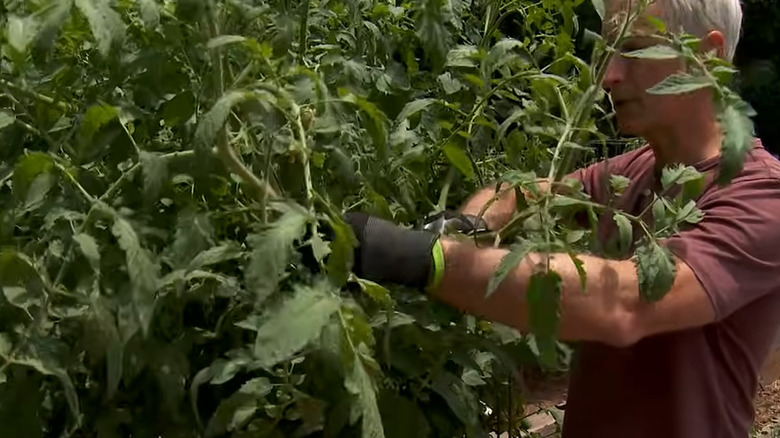
Knowing how to prune your tomato plants ensures a delicious harvest, even in September. Prepare your scissors or pruners by cleaning them before making any cuts. You can use 70% isopropyl alcohol or a 10% chlorine bleach solution diluted with water to disinfect the blades.
Then, identify where you want to cut. This is a bit of a guessing game, but look for the highest branch that has fruit large enough that it could reasonably still ripen. This can vary depending on the tomato variety you're growing. You're focusing on the main stem, and you want to make the cut above the last fruit cluster that you want to let ripen. Avoid cutting too much of the plant off — you could lose fruit that would ripen, and cutting off too many of the upper leaves could expose the remaining plant to sunscald.
When you find your location, make a clean cut on the main stem just above a leaf node — it's that simple. Pruning the suckers at the same time can direct the energy to the fruit that's already set. If you leave the suckers, the plant might put energy there instead of only to the existing fruit. If you decide you topped the plant too high, you can cut more. Just be sure to limit the amount cut to ⅓ of the plant to avoid over-pruning.