

Use A Heavy-Duty Tool To Smooth And Level Gravel Driveways

Time for everyone's favorite chore: Tidying up your gravel driveway. While there are plenty of ways to smooth gravel driveways without a tractor, having one available for maintenance is well worth the investment. Not only can a compact or subcompact tractor equipped with a front-end bucket loader scoop and refresh the driveway with new gravel, they also have enough horsepower to pull heavy-duty attachments like a scraper blade that will help keep your gravel driveway level and smooth.
Also known as rear blades, a scraper blade is one long blade that can be between 5 to 10 feet wide. The blade is attached to an arm and swivel which connect to a tractor's 3-point mechanical lift system. Scraper blades can come either with manual or hydraulic adjustments which control the angle, tilt, and offset of the blade. These allow you to adapt the blade to a number of different tasks, from plowing thrown-out edge gravel back to the center to smoothing out uneven patches over a long length.
Depending on the size of the blade, you're likely to spend anywhere from $1,000 for a manually adjusted blade to $5,000 for a hydraulic one. While it's a more expensive option than using an old wood pallet to level gravel by dragging it behind your lawn mower, a scraper blade is a great tool for those with long driveways and the equipment needed to maintain it.
How to use a scraper blade on a long gravel driveway
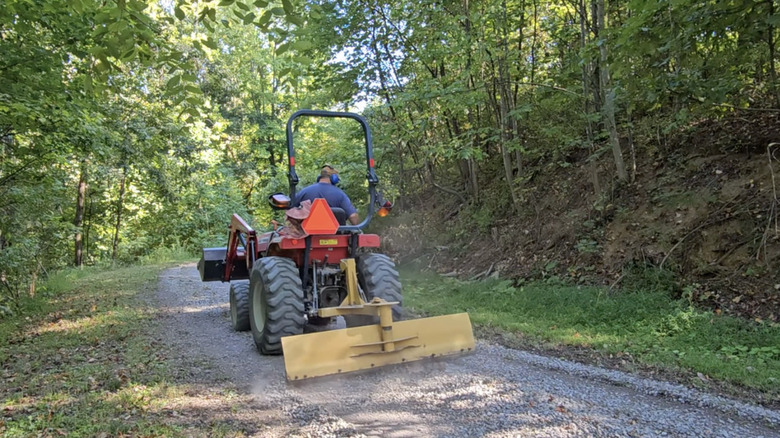
Though an expensive piece of kit, a scraper blade tractor attachment is far better than hand tools like bow rakes or hand tampers when it comes to maintaining longer gravel driveways. The tractor allows you to smooth out larger areas in a shorter time, with the blade being dragged behind the tractor to even out raised areas and fill in shallow potholes or low spots.
It would be best to do this when the sub-base of the gravel is damp, but not saturated or muddy. The added moisture will keep any dry dust from clouding up the driveway, and also help the dust bind which increases the compaction of the gravel alongside pressure from the tractor and the scraper blade. Make several passes in order to spread the gravel out evenly and ensure that the crown– the elevated center of the gravel that pitches the water away towards the edges– is maintained.
Now, if you don't have a tractor but still have a long, gravel driveway to take care of, you could always use a smarter way to smooth and level the gravel with a riding mower attachment. These tend to be lighter-duty graders and may require extra weight to stay connected to the ground. Though it would be a big initial investment, overtime, the tractor and rear blade would pay for themselves thanks to you saving money on professional maintenance.