

Skip Rakes: There's A Smarter Way To Smooth & Level Gravel Driveways
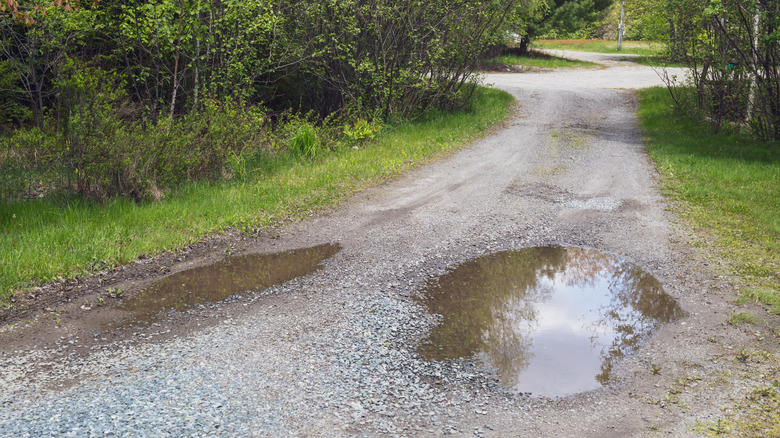
If you have ever tried to smooth gravel with a rake for anything more challenging than an uneven simple gravel path, you already know that this can't be the right way to do it. If you're fixing a rutted driveway, it's probably not a way to do it at all. And, while a lawn leveling rake can make short work of fixing an uneven yard, it won't survive gravel. So, assuming that a $400,000 John Deere motor grader is not in your budget, what's the right way to level a gravel driveway? A miniature version of the grader, attached to your riding lawn mower, of course.
Gravel driveways cost less than their concrete and asphalt counterparts but often require far more maintenance. For people without government road-maintenance contracts, the way to tame a gravel road or driveway has long been a tractor — an expensive and stubborn workhorse of a thing that will get the job done or flip over trying. For the average homeowner, this would be overkill in several senses. But a number of companies make lightweight implements specifically designed for riding mowers and their sturdier cousin, the garden tractor. These include land planes, box blades, landscape rakes, drag harrows, and specialized driveway graders. Box blades or box scrapers are heavy duty machines for ground that's more uneven than the typical driveway. You can think of driveway graders like the DR Power Grader (which typically costs around $900) or the Handozer Gravel and Soil Drag ($850) as a compact tractor version of a box blade. The cheaper land planes and drag harrows are designed for lightweight, final smoothing, and won't have much impact on underlying ruts or potholes.
Riding mower attachments come with some limitations
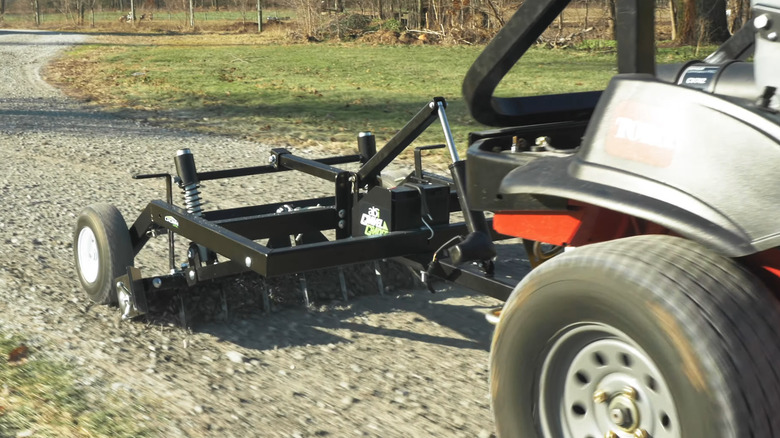
Tractor attachments are different from riding mower attachments in that they are a great deal heavier, and they leverage the power takeoff (PTO) and attachment options of the heavier-duty equipment that isn't typically available on basic mowers. PTO isn't much of an issue with graders and box blades, but adjustment is a big deal. On a typical tractor's three-point hitch, you can fine-tune an implement's height, its front-to-back angle, side-to-side tilt, and the amount of left-right sway you choose to allow. These capabilities are essential for grading, and one implement — the ABI Gravel Grader — effectively reproduces them within the attachment itself, except for the ability to raise or lower the entire unit. For example, its tines (ABI calls them "6-inch ripping teeth," although they only reach 1¾ inch deep) are adjusted via an integral toplink, which is usually a feature of a three-point hitch.
But the one thing ABI's Gravel Grader and similar products can't fix is the weight of the riding mower. This is a problem, since graders like ABI's turn the tow vehicle's weight into downward force on the implement. If you use a riding mower rather than a tractor, you'll typically have less weight at your disposal— a basic riding mower only weighs around 350 pounds, while a powerful garden tractor can weigh 1,000 pounds or more.
The other major limitation of quality graders is the price. For instance, ABI doesn't publish prices, and for good reason. The unit reportedly sells for over $2,000, more than even the best entry-level riding mower.
Cheaper (and DIY) gravel-leveling attachments
When choosing your grader, apart from taking into account the riding mower's weight, you should consider the grading needs. For instance, do you need to scarify the compacted soil or fine aggregate beneath the gravel to break up potholes? Do you have to redistribute large amounts of gravel that have been displaced over time? Or are you simply trying to level and smooth the gravel for a more finished appearance?
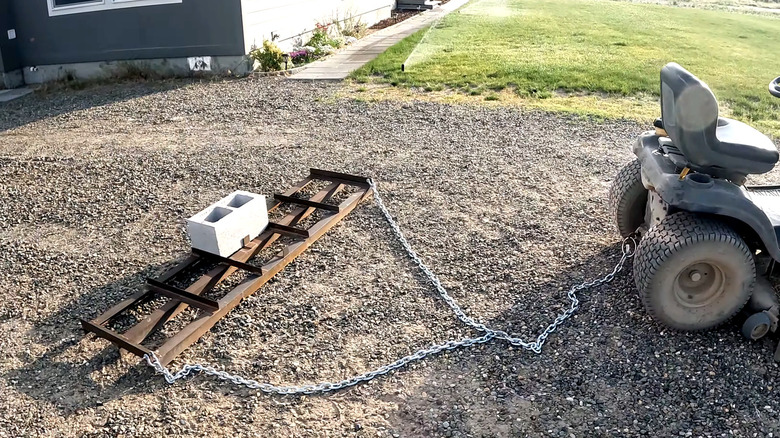
At the lower end of these needs, you might very well get away with a simple implement called a drag harrow — a broad term for a number of accessories you can, well, drag over gravel to smooth it out. You can drag a rigid steel frame like the Garvee adjustable-width drag harrow or opt for a steel mesh drag harrow with integrated tines, like the Garvee heavy-duty chain drag harrow. Rigid drag harrows are almost indistinguishable from some DIY versions, but those require welding. DIY chain harrows are less common, but they're often approximated by homeowners dragging around chain-link gates and wood pallets; the latter sometimes have long nails driven through them to serve as tines. Many commercially available grading tools allow you to add weights, and most DIY versions require it. One inventive soul, frugallandlord6974 (via YouTube), made the weight configurable by attaching a water tank to the implement; this allows the user to increase and decrease the grader load as needed.