

Brown Recluse Vs. Brown Widow Spider: How To Easily Tell The Difference
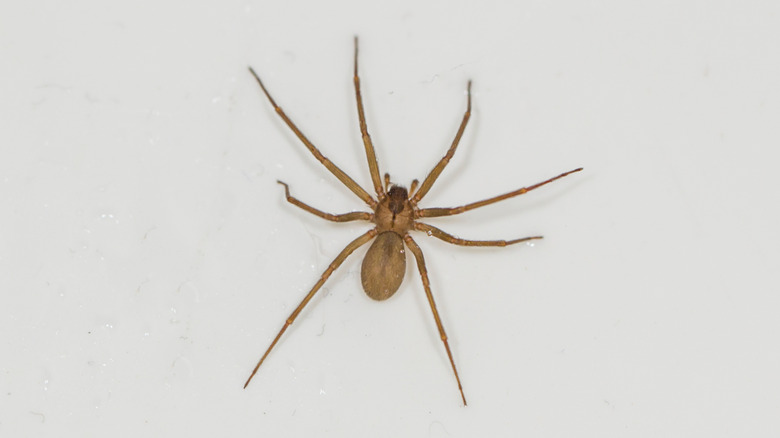
Most people struggle to tell brown spiders apart. Unless they've been safely captured inside a glass jar, where there's little risk of them biting you, folks would avoid venturing close enough to peek at their anatomy. And it makes sense. After all, depending upon where you live, it could be a brown recluse spider, whose bite can, albeit rarely, create dead tissue that usually takes several months to heal. So, it is best to avoid being bitten by a brown recluse spider.
But more commonly, odds are that you're dealing with one of the many look-alikes of the brown recluse, like a cellar, wolf, or southern house spider. Others also misidentify brown widow spiders for them. However, as ACE-certified Hybrid Education Facilitator Scott Svenheim at Truly Nolen, tells Hunker in an exclusive interview, such conclusions are incorrect because they don't have much in common. "There is really nothing similar about them except size," Svenheim explains. Excluding their leg span, both can be about ⅜ inch or 10 millimeters long, though male and immature spiders are often shorter. While brown recluse and brown widow spiders may share brown as a common denominator — in their name and on their bodies — you can differentiate them by their body markings and eye settings.
Brown recluse has a violin marking, while brown widow shows an hourglass
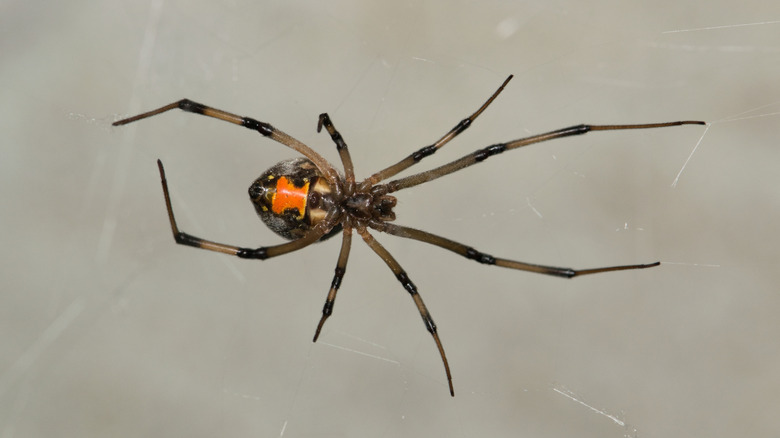
Brown recluse spiders, tellingly, go by other names like violin or fiddleback spiders, which refer to the markings on their bodies. "Brown recluse spiders are tannish in color and have the distinctive 'violin shape' on the top of their cephalothorax (head/thorax combined)," notes Svenheim. In addition, their abdomens — the section attached to their cephalothorax — have a uniform brown color, sans any pattern or spotting. If you examine them closely, you'll also find that, as opposed to most spiders, they only have six eyes, often arranged in equal-sized pairs of three.
In contrast, the brown widow spider has the usual eight-eye structure, split across four rows. It features black accenting on its body and also shows tan and gray hues. Add to that, on their abdominal undersides, they show an hourglass marking, differentiating them further from brown recluses. "They generally have very long striped legs, a sometimes-patterned abdomen, and the usual orange hourglass marking on the underside of their abdomens, instead of red like Black Widows," clarifies Svenheim.
Beyond physical characteristics, location matters. Unless they've hitchhiked a ride, most spiders aren't found outside of their habitat range. "Brown Widows can be found in California, Arizona, Texas, and the Southeast," explains Svenheim. "True Brown Recluse spiders can be found in the south-central and Midwestern United States, with the strongest range from parts of Nebraska and Ohio south toward Texas and Georgia, with various other species occurring in Southeastern California, Arizona, and New Mexico."
Danger of and dealing with brown widows or recluses
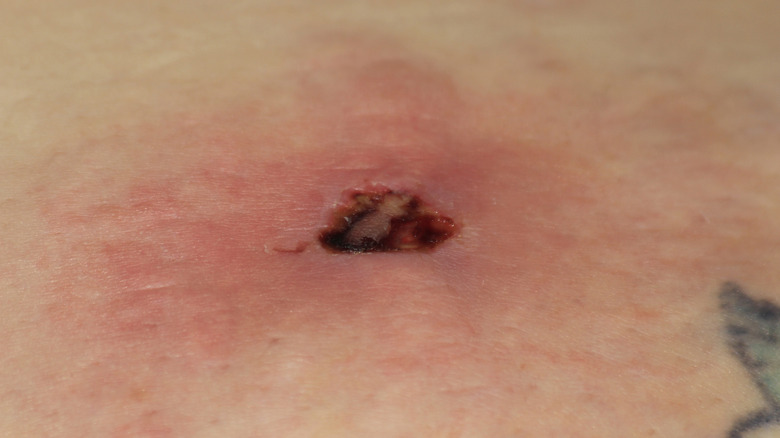
Brown recluse and brown widow spiders aren't the type to seek a fight. "Both spiders would prefer to run and hide rather than bite," notes Svenheim, "however, they will if they feel threatened or trapped and need to defend themselves."
The damage each spider does can be notably different, with brown recluses being the more dangerous of the two. "Their venom is necrotic in nature, sometimes causing quite an infection and scarring if not cared for by a physician," Svenheim warns. In comparison, the bite from brown widow spiders is milder, with pain levels being similar to a common house spider's bite. However, their venom is as toxic as a black widow spider. For this reason, our expert recommends a hospital visit, just in case. Moreover, Svenheim adds, "Bites from either spider can be dangerous for some individuals, especially those who are very young, elderly, or already have a weakened immune system." So, exercise caution when trying to get rid of spiders.
To bring an existing spider infestation under control, Svenheim advises hiring a regular pest control service. Be sure to remove their food sources (read: insects), so they'll have little reason to hang around your home. As preventative measures, Svenheim concludes, "Proper yard care, maintenance, and sanitation are a good place to start." This is because throwing out debris or clutter deprives spiders of crucial habitat.