

How To DIY A Level For Your Lawn Using Scrap Metal

Bumps, dips, and uneven terrain can become a major issue for your lawn, whether it's because of hazards, problematic water pooling, or simply the eyesore of it all. Fortunately, minor imperfections don't necessarily call for tearing up the grass and starting from scratch. Instead, many lawn enthusiasts opt for top dressing to help level the playing field.
Top dressing is a relatively simple process used to fill up minor lumps, bumps, and divots in lawns. This DIY lawn leveling trick involves filling in low areas — typically with a mixture of soil, compost, and sand — but the tricky part is leveling the lawn afterwards. A lawn leveling rake makes it easier to spread that material across the grass and work it into low spots, but there's no need to shell out for a specialized tool if you're willing to do a little scrappy DIY work.
YouTube creator Don of Don's Lawns embraced the idea of leveling a lawn without pricey equipment. He built his own custom lawn leveling tool using some scrap metal, a circular saw, nuts, lock washers, bolts, and a threaded utility handle. There were some bumps along the way, but his trial-and-error approach offers a few useful lessons for anyone planning to follow his lead.
Crafting a DIY lawn leveling tool
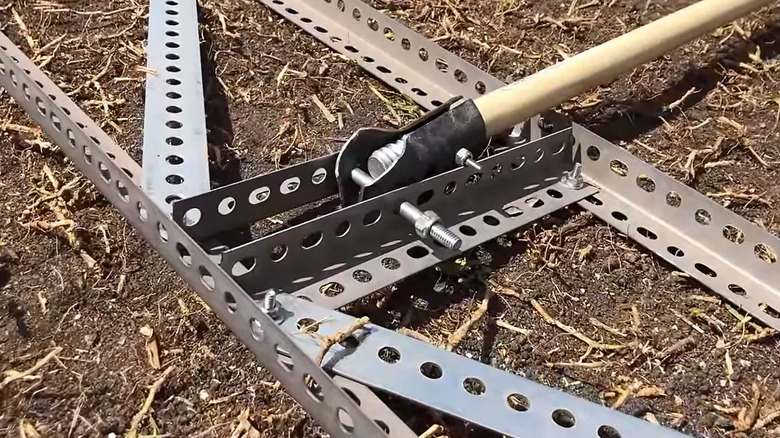
Don begins building his lawn leveling tool with 18-gauge slotted angle metal, cutting it into pieces and bolting them together to form the leveler's roughly 36-inch-wide base. Nuts, bolts, and lock washers hold the frame together without requiring any welding. Discovering that the frame has more "play" than he'd like, he reinforces it with flat bars positioned diagonally for better stability and rigidity. In a similar battle against flimsiness, Don abandons his idea of using PVC for a handle, opting instead for an 18-inch threaded utility handle. He attaches the utility handle to the center of the frame using a metal bracket and bolt, making sure the mounting hardware won't extend far enough underneath the tool to dig into the ground as it moves across the lawn.
Don's tutorial wasn't focused on replication, though he does offer specific details for those who prefer instructions over improvising. Slotted angle metal makes assembly convenient since the holes eliminate much of the drilling, but other sturdy metal strips or bars could work if you have the tools to cut and drill them. You also don't have to purchase a utility handle if you've got an old broom or rake. Just focus on achieving a rigid, flat base without protruding hardware that could rip up the grass or dig into the soil. Top dressing won't work for major dips from tires and the like, but it can be a quick fix for minor imperfections.