

The Flooring Guideline Most Homeowners Don't Find Out About Until It's Too Late
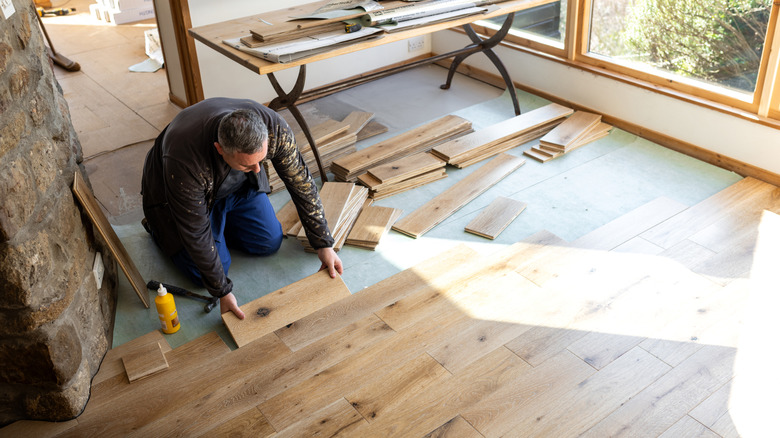
Flooring projects are challenging, especially when it comes to knowing how much material to buy. It may seem obvious to order the same amount as the area of your room. If you're redoing a 200-square-foot spare bedroom with a stunning flooring option, you might buy 200 square feet of material. However, most homeowners find out the hard way that this is seldom enough. You may be nearly finished with the project when you realize you don't have enough flooring left. The standard rule of thumb is to order 10% extra flooring.
While planning your project, note doorways, vents, and angled walls of the room in question, which require the flooring to be cut to fit, leaving you with some unusable scraps. Then consider the mistakes inherent in home improvement, like incorrect measurements. You'll see why the 10% extra rule is the guideline that works for most homeowners. If you run out, you may think it's no big deal to pick up another box of the flooring to finish the job. But you may find out too late that the new flooring's color and pattern may be slightly different than the first batch.
Before ordering material, you'll need to know how to calculate total square footage. Multiply the length and width for rectangular rooms. Let's say our bedroom example is 20 feet long by 10 feet wide, which adds up to 200 square feet. Add 10% (20 square feet) on top, meaning buy at least 220 square feet of material. Irregular rooms require a different approach: measure each section separately and add them together. For example, if the rooms has a closet, add its footage to the bedroom's.
When the 10% guideline works best
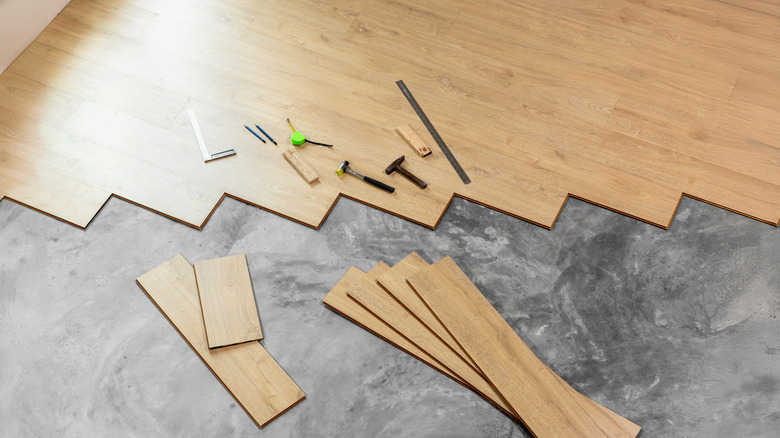
Most homeowners find that the 10% flooring guideline works best for relatively straightforward projects. If your room is square or rectangular and doesn't have obstacles, such as obtuse corners, stairs, closets, or other elements, adding 10% extra flooring should be enough to cover everything. The same generally applies when the flooring is installed straight from one side of the room to the other, rather than diagonally or in a pattern such as herringbone flooring. For standard vinyl, laminate, hardwood, and other such types of flooring, 10% is a good starting point for most projects.
The extra material also accounts for flooring that may be slightly defective or flawed right out of the box. Rather than installing a damaged, discolored, or otherwise imperfect piece, you can set it aside and use a better-looking piece in a more visible location. This can be particularly useful when using natural hardwood, where variations in color and grain are common.
However, if you're redoing a small closet with only four corners and no interruption, you may be able to get away with a 5% overage. On the flip side, if the job is more complicated, or you're doing multiple rooms, consider adjusting your budget to account for 15% extra material. In any case, keeping at least some extra flooring can save you headaches later. If a section becomes damaged, you'll have replacement material that matches the original. Finding an exact match years after installation can be difficult, especially if the flooring has been discontinued or changed by the manufacturer.