

Carpenter Bees Vs. Bumble Bees: How To Easily Tell The Difference
If you've ever been stung by a bee, you know exactly how painful it can be. It's one reason many people get nervous the minute they hear buzzing nearby. The good news is that not all bees sting. With over 4,000 bee species in the United States, learning to identify the most common types if you find a hive of bees at your house can help you interact with them safely. Carpenter bees and bumble bees are both highly active in the spring and summer. At first glance, they look very similar, but there are some key differences.
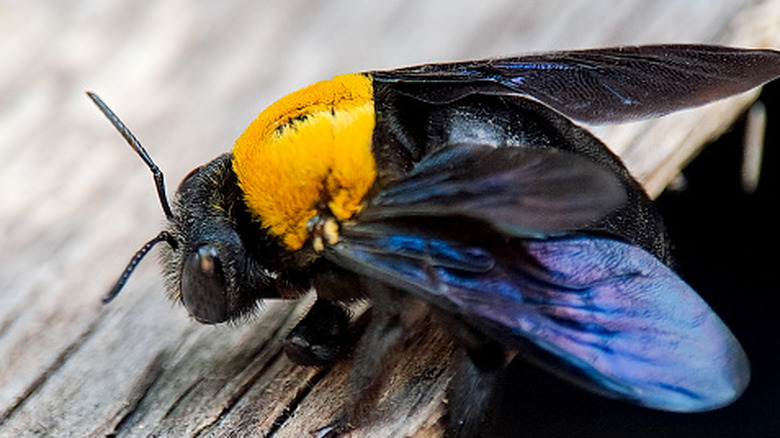
Carpenter bees, the largest native bees in the United States, are thick-bodied, large insects, with some species growing up to an inch long. Even though they may appear intimidating, they are calm unless provoked. Female carpenter bees use strong mandibles to chew into wood, creating long tunnels that can break down a structure. That's why it's worth paying attention if you find a carpenter bee nest along your eaves or see them coming in and out of the side of your home. Inside the tunnels, the females lay eggs, mixing saliva with sawdust to build protective partitions. Males usually die after mating, while some females can survive up to three years.
Bumble bees also look very plump. Instead of boring into wood, they like to build their nests underground, especially in old rodent burrows. They are very peaceful bees but will defend their nests if they feel threatened, such as when you run over their nest while mowing grass. Usually, these bees fly away rather than sting, though they may also buzz aggressively as a warning. When winter arrives, the colony dies off except for the mated queen. She hibernates and then becomes active again in the spring.
Other ways to tell carpenter bees and bumble bees apart
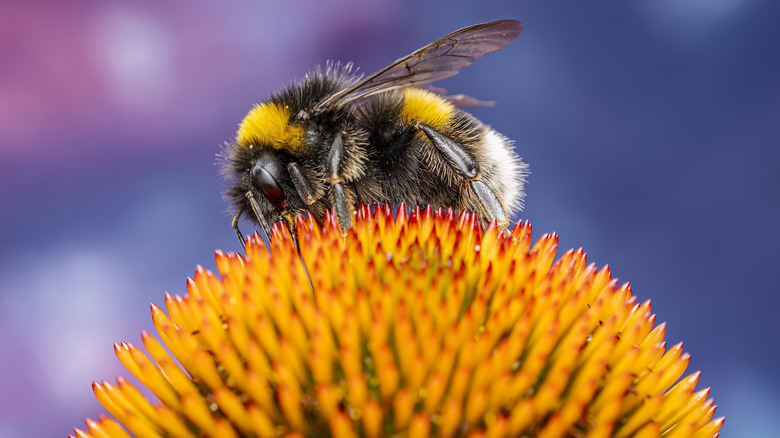
The easiest way to tell a carpenter bee from a bumble bee is by looking at the abdomen. Bumble bees are covered in soft, fuzzy hairs, often with their iconic yellow and black stripes. Female carpenter bees normally have shiny, relatively hairless abdomens, while males may have a yellow or white spot on their heads.
Another way to tell the difference between the two bees is by noting their flight pattern and behavior. Male carpenter bees are very territorial. The males hover like tiny helicopters and may even fly right up in your face to inspect you. However, since the males don't have stingers, this dive-bombing tactic is completely harmless. Bumble bees focus most of their attention on foraging and tending their nests. They will generally ignore you if you leave them alone.
Bumble bees are very social insects, too. They live in colonies that feature a queen and between 50 and 400 workers. If you look closely, you can see the bees carrying colorful clumps of pollen on their hind legs. Carpenter bees tend to be more solitary. Females typically build their own nest, and they carry pollen on the hairs of their legs. If you find carpenter bees nesting along your roofline, each hive has one female and one to five males.