

The One Thing Your Peony Plants Need In Fall For Big & Beautiful Spring Blooms
We may receive a commission on purchases made from links.
Fall is quickly approaching, but that doesn't mean gardeners are hanging up their gloves anytime soon. Sure, temperatures are cooling off and the growing season is winding down, but early autumn can be a perfect time to prepare for a bountiful garden the next spring. If you've spent spring and summer learning how to grow peonies (Paeonia spp.), dividing them in early September will provide more blooms to work with come next year. When it comes to dividing, essentially, you're carefully splitting a plant at its roots to create two or more smaller plants. It's a form of propagation.
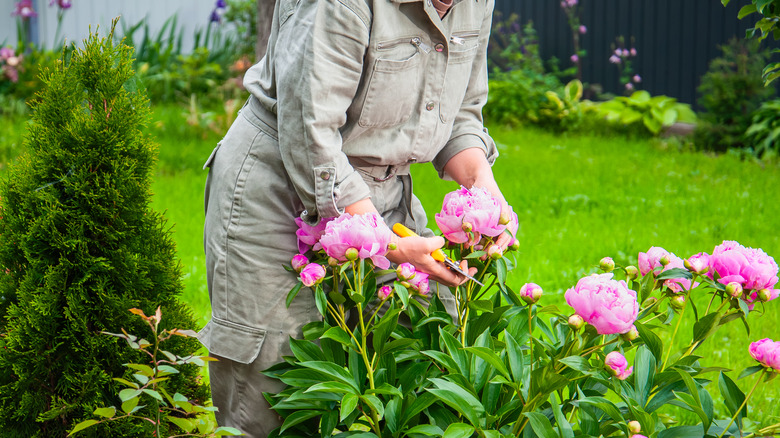
One of the most beloved florals, peonies are delicate pink perennials that embody spring, emit a gorgeous fragrance, and can be planted in Zones 3 to 8. But they can be complicated, and they're not necessarily an easy flower to grow. Peonies take about three years to begin really flowering and only flower for a few weeks from April to June. That being said, they tend to get pretty comfortable where they're planted and don't technically need to be divided once established. So you really only need to consider dividing them if you'd like more plants, if they've become unruly, or if you want to pot a few.
Whether you're caring for peonies in the fall or considering dividing them, the experts at Fraser Valley Rose Farm break down why this time of the year is essential. After remaining somewhat inactive during the latter half of the summer, the leaves get busy gathering energy and scooping up nutrients for the plants crowns, in preparation for winter. Essentially, peony root development is at its prime in early autumn.
How to divide peonies in the fall
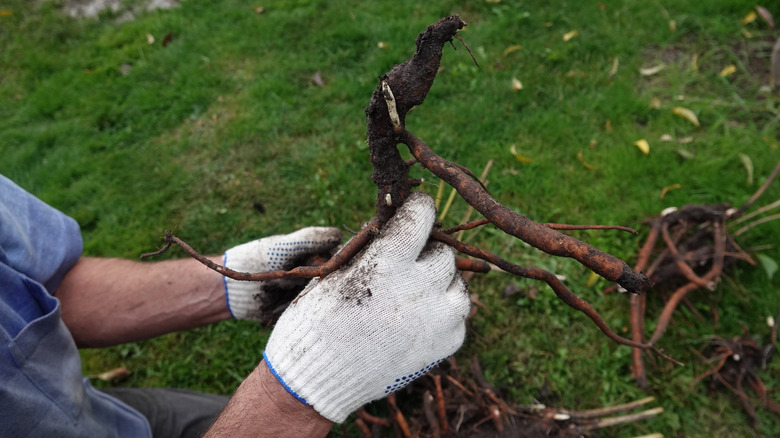
When it's time to actually divide the plants, first cut the stems down to ground level (this helps them thrive after transplanting so they don't "sulk"). Then use a pitchfork to loosen the soil and make the heavy lifting a little less so, without damaging the roots (it's going to be a large clump of tubers). When you feel as though you can grab the whole peony clump — roots and stems — dig it up and give it a quick brush-off cleaning. Then, using a knife or snips like Fiskars pruning shears, cut off the stems and divvy up your roots with three to five "eyes" per section that will create new stems in the spring. The Fraser Valley Rose Farm pros recommend curing the clumps for a few hours in a semi-shaded locale to remove excess moisture and prevent rotting.
Once you're working with dry clumps, dig around the depth of your shovel blade, roughly 6-8 inches, and place your peony clump with its three to five eyes in the dirt or a 2-3 gallon pot to ensure they have enough room to grow. Keep in mind that you should keep the peony's eyes about two inches from the surface, no deeper. Researchers at Iowa State University then suggest watering the peony clumps, but don't be heartbroken if only a few peonies flower in the spring: It takes awhile for them to show up — sometimes even a full year — but they're well worth the wait.