

Triangle Spider Webs: What To Do If You Find One In Your Home Or Yard
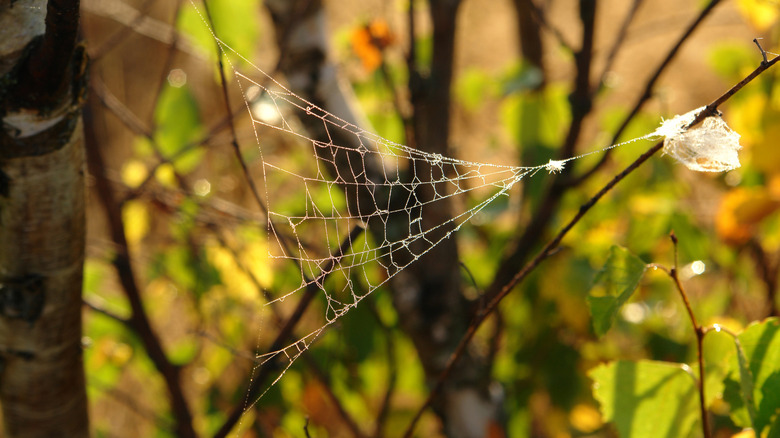
Walking face first into a triangle spider web can seem like a sticky situation. But what makes the whole experience worse — mentally and momentarily — is the likelihood that a tiny weaver may be hurtling at you at 1,700 miles per hour at that moment. To gain this speed, a cheetah would have to accelerate at 60 times its maximum sprint rate and a NASA shuttle 26 times. The redeeming feature? On discovering it's not a snack (read: bug), but a big-sized human that is butting heads with its web, the weaver generally reels back, restoring its web to its previous, stiff triangle form. In short, it is still hungry, so you may as well leave the triangle web in its place if it isn't in the way until the arachnid feeds and goes away on its own.
If you've ever set about to identify different types of spider webs around your home and yard, you may have noticed a huge divergence among spider species. Hammock spiders plait sheet webs, while house spiders create a tangled mess. Orb-weaver spider webs look even more different in their artful circles, and some days, you might come across triangle webs, which look like they were sliced out as a pie-shaped wedge from an orb weaver's web. Created in a Y-shaped form, rather than going slack, a triangle spider web holds taut because its maker, the triangle weaver spider (Hyptiotes cavatus), pulls at it for hours, if not days. When an unfortunate moth or a fly comes close, it releases its web like a slingshot to capture its prey, dismantling the web in the process.
Triangle weaver spiders are harmless
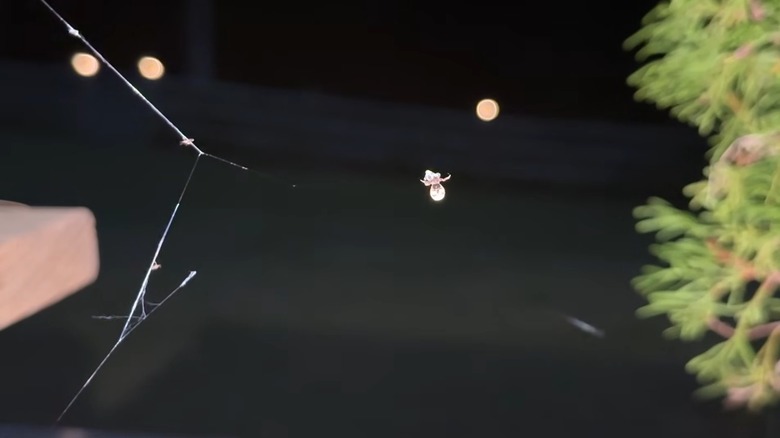
Triangle weaver spiders belong to the family of cribellate orb weavers, a species that stands out for its lack of venom. In fact, these spiders don't even have any venom glands. So, landing an annoying bite on humans or your pets is out of the question, making them completely harmless.
Besides, because they're highly aware of their limitations, they tend to hunt solitarily, primarily dominating woody areas, keeping well away from homes. At most, you may spot these triangle webs on tree limbs and shrubs, if you own a woodlot or a landscaped area, or maybe on your lawn chair if they mistake the wooden slats for branches (they are, after all, short-sighted). And if you trace the web back to its origin, you may spot the grain-sized spider, trying to pass off as a bud. Since it's colored brown or gray and is at most one-eight of an inch long, it easily camouflages itself in the vegetation.
Dealing with triangle spider webs

Given their harmless nature, if you ever see a triangle web, consider using the opportunity to watch triangle spiders in action. To make up for their lack of venom, they utilize this slingshot method to ensure they trap the insect from a safe distance, or it might get a chance to turn the tables (or flee from the web). These spiders usually wait at one tip of their triangle web and, at the same time, thread an anchor line to the tree branch behind. When a prey comes within earshot, they let go of the anchor line, hurtling themselves and their webs at the prey at a breakneck speed, enmeshing it in the fuzzy threads. Depending on the target's size, they may repeat this process multiple times until the target is completely trapped. As such, they use the entire web to catch a lone insect!
On the other hand, if they think the bug in question is their predator or a human, they quickly trace their steps back, reinstating the previous situation. Due to that, you don't really need to worry too much about their presence. However, if they're taking up extra space that you deem must be relinquished immediately or you have arachnophobia, you can easily get rid of their spider webs by destroying them with a newspaper or your trusted shoe. Odds are the spider will scurry away while you're at it, or you can thwack it afterwards with a fly swatter. Alternatively, you can vacuum the whole thing up and discard the contents in the trash.