

Orb-Weaver Spider Webs Look Different: Here's How To Identify One In Your Home Or Yard
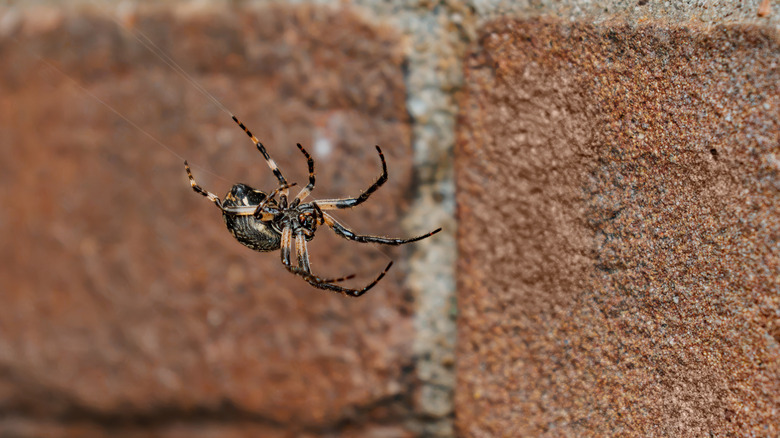
Different spider species create webs suited to their hunting strategies and living environments. And because there are many types of spiders lurking around your home, you are likely to see various types of webs. There are dusty webs from cobweb spiders that look like they are straight from a horror movie, plus the silk lines left behind by wolf spiders who are trying to socialize with each other. However, orb-weaver spider webs differ from those spun by other species. Their webs are the classic, symmetrical, oh-so-intricate artistic displays that you are likely picturing when you think of a spider's web. To identify one in your home or yard, look for the telltale round, repeating pattern made by the weavers as they connect the threads.
You will typically find orb-weaver webs anchored between two sturdy midpoints, like two beams on your front porch or the limbs of a tree. They also use the ceiling as the web's anchor, with a point halfway down the wall serving as the second anchor. Inside your home, you might find them building webs near windows, so you'll need to learn to keep spiders out of windowsills by making it less hospitable to them.
How orb-weaver spiders craft unique webs
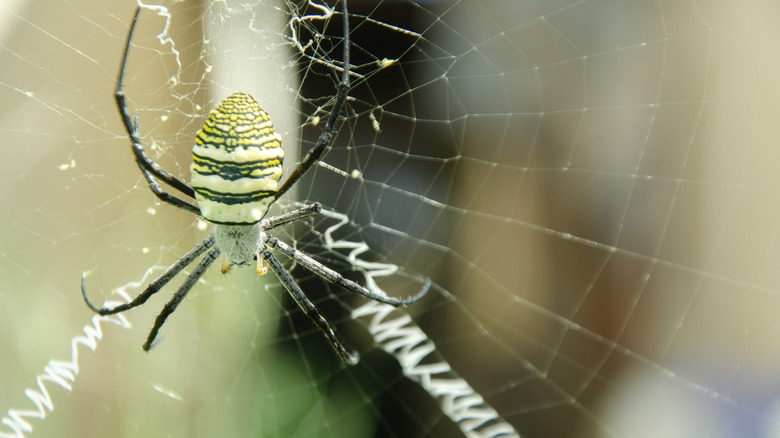
If you notice a little variation between the webs on your porch from day-to-day, you're not imagining things. Every evening, the orb-weaver spins a new web. This way, the silk is fresh and unbroken. A new web does a better job of catching food. An orb weaver spider starts by eating the previous web. Then, the spider releases a strand of silk and waits for it to attach to an anchor point. From there, the arachnid releases one more strand to create a Y-axis. This junction allows the creature to begin branching out and creating the familiar repeating geometric designs.
You might also see zigzags in the web that look a bit thicker than the rest of the silk lines. These are called stabilimenta. There is some debate over what they are for. Some hypothesize that they add more stability to the piece, hence their name. Recent research even suggests that some species of orb-weavers might craft the stabilimenta to look like larger spiders, perhaps as a bit of a scare tactic. If prey is distracted, the spider has a better chance of sneaking up on it. That said, you shouldn't kill spiders in your home so they can take care of flies, mosquitoes, and even ants for you.