

Why Settle For Plain Gravel Driveways When This Tougher, Better-Looking Alternative Exists

We may receive a commission on purchases made from links.
Out of all the things to be excited about in a home, it's rare that someone gets amped over a driveway. Yes, it has to be sturdy, but that doesn't mean it has to look utilitarian and totally boring. One way to make a beat-up driveway look fresh again is to use interlocking concrete pavers for the driving surface and save the gravel for decorative borders. The pavers create a better-looking and more stable path beneath vehicle tires, while the loose stone can add contrasting color and texture along the edges.
Concrete pavers offer more variety than their name might suggest. You can complement a home's exterior with different tones, enhance contemporary architecture with large gray geometric units, or combine two colors to create a unique design. Running-bond and herringbone patterns can further add character, with the CMHA noting that the latter is better for surfaces carrying vehicle traffic because it provides strong load support.
Cost is another important factor when choosing a driveway material, and this makeover won't be a money-saving one, at least in the short-term. Pavers demand a larger upfront investment and more preparation than spreading gravel. But it might be worth it in the long haul, as gravel surfaces can develop ruts and potholes. Gravel drives that see high use can require annual regrading, something properly installed pavers don't need. And if a repair does need to happen with pavers, the individual units can be lifted and reused.
Build a strong base and contain the gravel border
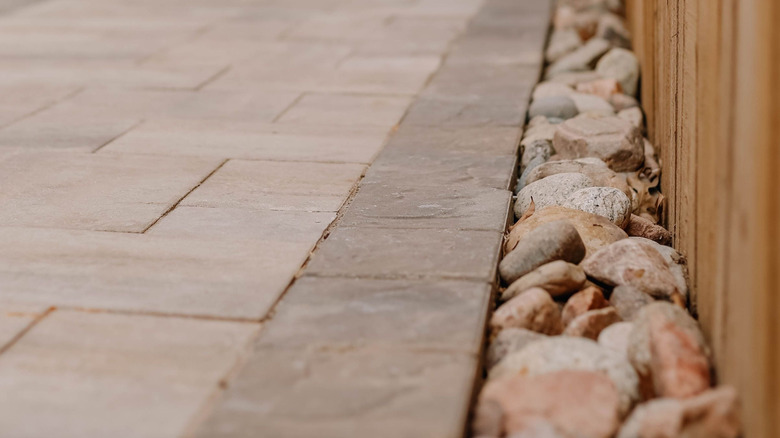
Here's the thing — the attractive surface of a paver-laid driveway is only as reliable as the foundation underneath it. You must excavate enough to accommodate the pavers, bedding layer, and compacted aggregate base. A minimum 6-inch base for residential driveways is recommended under ideal conditions (additional depth might be needed where soil is weak or drainage is poor). It's also best to use a road-base aggregate that's similar to what your local municipality uses, rather than something like pea gravel or river rock. Finally, make sure you compact the base thoroughly before screeding the bedding sand and laying the pavers.
The gravel border will be purely decorative rather than part of that structural foundation. Secure the perimeter of the paver field with a proper edge restraint, then install another border between the gravel and surrounding lawn or planting bed. Do not skimp on the edge restraint (something like poured concrete curbing or plastic/metal landscape edging) as it will prevent your pavers from spreading.
While you could technically pour the gravel directly onto the dirt, laying down landscape fabric before pouring the stone will help prevent it from sinking into the soil. Sadly, it is not a permanent weed solution because leaves and other organic debris will eventually collect above the fabric, which can create a breeding ground for airborne seeds to germinate. Because weeds can root into or through the edging, you'll still need to hand-pull young growth to successfully keep weeds from growing in gravel. For a finishing touch, add solar lights (these Tenmiro Solar Pathway Lights could be an attractive option) on top of the gravel or along the outer edge.