

Will Cleaning Vinegar Kill The Grass In My Flower Beds?
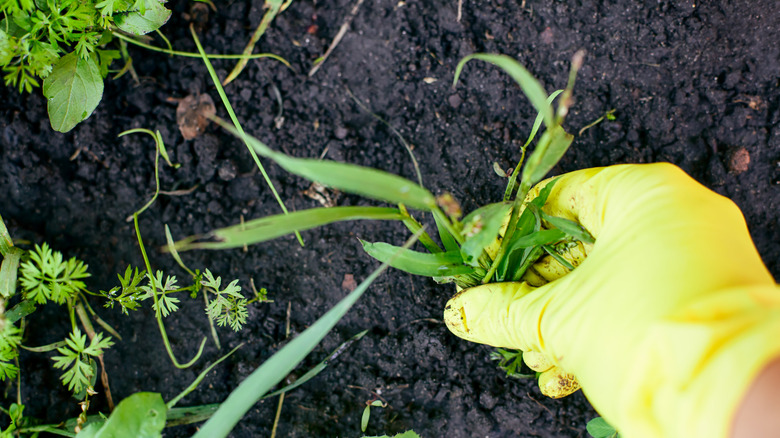
Grass and flower beds are the building blocks of a beautiful landscape, but when the former encroaches on the latter, things can get messy. If you've found success using cleaning vinegar for weeds, or if you're curious about the application, you might be wondering whether cleaning vinegar will kill the unwanted grass growing in your flower beds. The short answer is yes: It can with regular application, but there are a number of caveats to consider before bringing out the bottle.
To start, there's an important distinction to make between cleaning vinegar versus regular white vinegar, and this has to do with acetic acid, vinegar's active ingredient. Regular white vinegar is usually 5% acetic acid, while most cleaning vinegars contain around 6% acetic acid. Acetic acid works as a contact herbicide, meaning it damages the plant tissue it actually touches rather than traveling through the plant to kill the roots. Upon contact, it breaks open plant cells and causes the foliage to dry out, killing the plant if the application area is broad enough. This makes vinegar far more effective on small, young weeds than on established grasses with well-developed root systems.
So, if you're trying to remove a few stray shoots of grass from a flower bed, cleaning vinegar may burn back the foliage, but it's not necessarily a permanent fix. And because acetic acid doesn't know the difference between unwanted grass and the pollinator-friendly plants you've been cultivating since last summer, applying it takes an extremely precise hand.
Using cleaning vinegar in flower beds
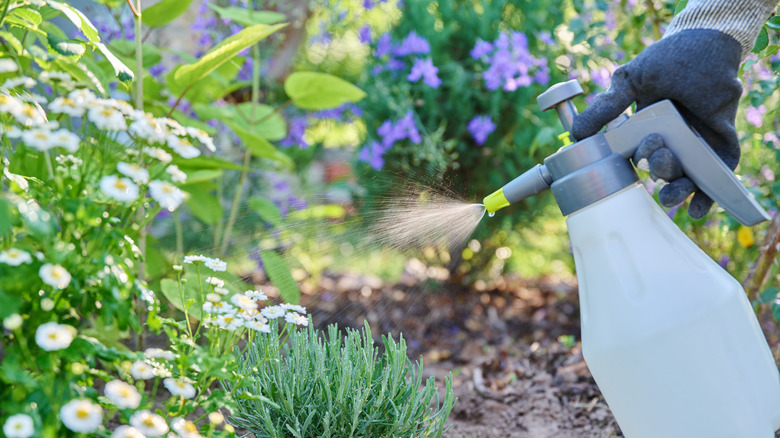
The biggest drawback to using cleaning vinegar in a flower bed is that it's non-selective, so any foliage it touches can be damaged, including the flowers, shrubs, and other plants you actually want to keep. Similarly, because it only targets the foliage it touches, grasses may wilt after treatment but grow back later because their roots remain alive.
Cleaning vinegar can also affect soil microbes and soil pH, but these changes are generally minimal and only last a few days without leaving a lasting residue. That doesn't mean repeatedly soaking a flower bed with cleaning vinegar is a great idea, but a careful spot treatment is unlikely to permanently ruin the soil microbiome.
All that considered, if cleaning vinegar is still a remedy you'd like to try for the grass in your flower beds, there are a few things to keep in mind. Kitchen vinegars at 5% acetic acid or your average 6% concentration cleaning vinegars are usually too weak to kill anything beyond very small seedlings, while stronger 10% to 20% acetic acid products are more effective. For example, horticultural vinegar is a more effective weed killer, with a typical acetic acid concentration of 20% or more. When working with acetic acid concentrations of 11% or more, always use extreme caution and wear gloves, long sleeves, and protective eyewear to avoid serious injuries. Lastly, be sure to use a surfactant (such as dish soap or yucca extract) to help the treatment stick to the grass leaves for maximum effectiveness.