

Cleaning Vinegar Vs. White Vinegar: What's The Difference?
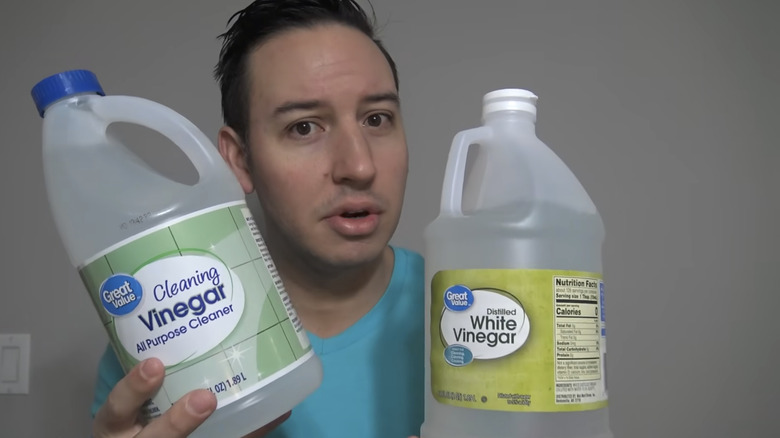
Vinegar has been a staple in homemade and natural cleaners for generations, but some varieties are stronger than others at busting dirt and grime. There are many types of vinegar, but for cleaning the home, both white vinegar and cleaning vinegar can be useful. Distilled white vinegar is the variety most commonly recommended for household cleaning and is suitable for a range of surfaces. Cleaning vinegar is very similar but slightly stronger than standard white vinegar. Both are clear liquids made primarily of acetic acid, which makes them effective cleaners and also explains their disinfectant properties.
White vinegar typically contains 5% acetic acid, while cleaning vinegars often have 6%. At those concentrations, the two products perform similarly for many household cleaning tasks. However, some cleaning vinegars contain much higher amounts of acetic acid, with products reaching 30%. That's why it's crucial to pay attention to the dilution. White vinegar is intended for cooking, food preparation, and food preservation, including canning, while cleaning vinegar is not food-safe. Though both products work well as household cleaners, there may be times when you want a more powerful solution. Before using either vinegar, check the label to confirm its exact concentration and recommended uses.
How white vinegar and cleaning vinegar are used to clean
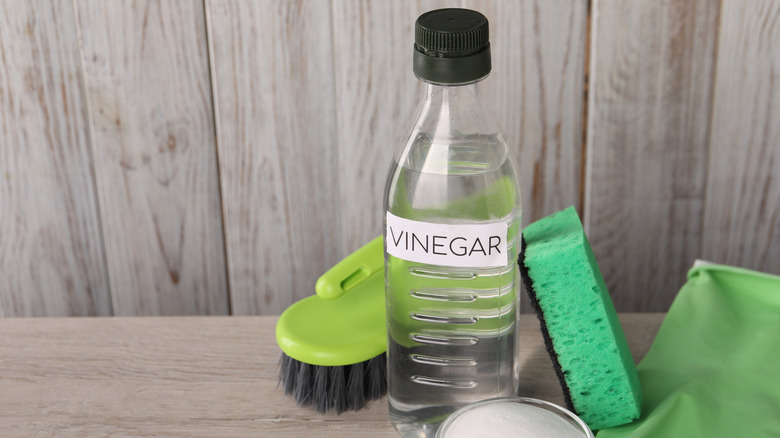
As more people look for alternatives to some conventional cleaning products, many of which are highly chemical, vinegar cleaning hacks are everywhere now. For everyday tasks or an all-purpose cleaner, the white vinegar already in your pantry is often enough. White vinegar is commonly recommended to remove buildup from hard water and to clean countertops and hard floors. Diluting distilled white vinegar with one part water is a common DIY solution, though it further lowers the concentration of acetic acid. If you find that your 5% white vinegar isn't strong enough for the job, try using a 6% cleaning vinegar for a little boost.
Since the concentrations are so similar, both cleaning and white vinegar can generally be used for the same tasks. Both can help remove odors from laundry, treat some stains, and act as a natural fabric softener when added to the rinse cycle. While white vinegar is also used as a mirror and glass cleanser, cleaning vinegar may be too strong for this job unless diluted. White vinegar also isn't always the best at cutting grease, so higher-strength cleaning vinegar may work better for especially greasy messes. That said, acidic cleansers aren't suitable for every surface. Wood and natural stone, for example, are things you should avoid cleaning with vinegar.
Stronger vinegars may be better for disinfecting
Vinegar is also commonly promoted as a natural disinfectant. But while it is known to have antibacterial, antifungal, and antimicrobial properties, research shows that the lower concentrations found in household solutions aren't always strong enough. For people who want to sanitize or disinfect with vinegar, a 2020 study published in BMC Microbiology found that a 10% acetic acid solution, particularly when combined with 1.5% citric acid, was more effective against a wider range of bacteria and germs than lower concentrations. In the laboratory testing, the solution eliminated E. coli, A. brasiliensis, and P. aeruginosa, but not S. aureus.
While this study suggests that household vinegars probably aren't strong enough to work as your primary disinfectant, other research has found that weaker solutions can kill some harmful pathogens. A 2023 study revealed that 6% acetic acid can inactivate SARS-CoV-2 after 15 minutes of contact time. And so if you choose to use vinegar as part of your cleaning routine, the available research suggests that higher concentrations of acetic acid generally have greater antimicrobial activity than standard 5% white vinegar.