

Cobwebs Vs. Spiderwebs: How To Easily Tell The Difference
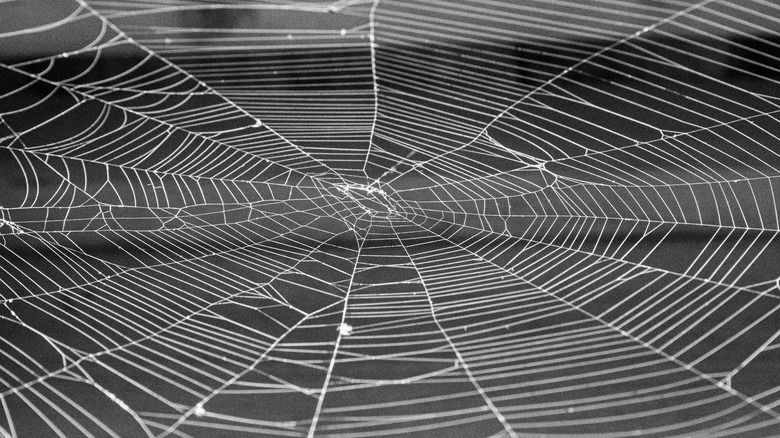
A cobweb is just a spiderweb that has been abandoned, but that knowledge alone won't help identify a cobweb if you happen across one. Some spiders hang out prominently in the middle of their webs, but others don't, so the absence of a spider doesn't necessarily mean a web has been abandoned. There are other ways to tell if it's safe to simply brush the web away, though.
Different spiders weave different kinds of webs, and they use them for different purposes. The classic geometrical ones are usually large and prominently placed, because their purpose is to catch insects. If you see one covered in dust, perhaps even with some dead insects stuck to it, it's probably an abandoned web. The owner likely died or crawled off to find a partner and never returned. Some spiders use webs to travel around the house and leave them hanging when they reach their destination. These cobwebs are a dusty, sticky nuisance, and you can safely get rid of them, too.
There's a whole family of spiders (Theridiidae) that includes house spiders and black widows called cobweb spiders. Their webs are tangled and asymmetric, and it's hard to tell if they're abandoned. The brown recluse weaves a similar type of web, although it doesn't belong to this family. You could get bitten if you simply brush a black widow or brown recluse web away, but the likelihood of that happening is slim, because it's usually hidden.
How to remove cobwebs safely
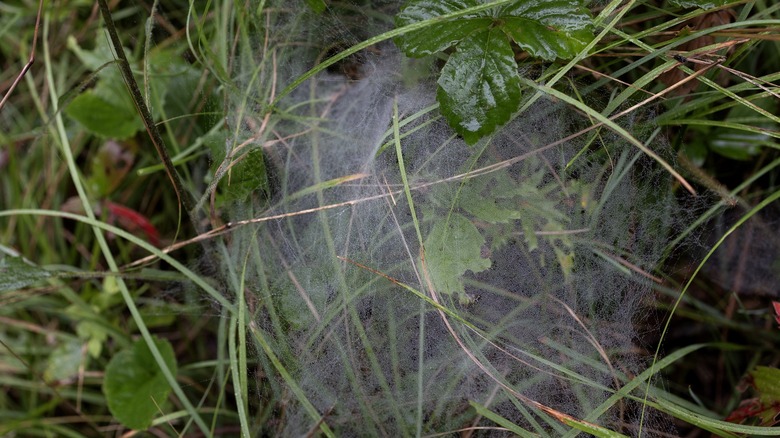
Cellar spiders, sometimes called daddy longlegs, weave webs that look like cobwebs because they tend to weave new webs over old ones instead of abandoning them. They favor the corners between walls and ceilings where prey is plentiful, and the webs are highly visible and collect a lot of dust. You can safely remove one with a broom or brush whenever whenever you see it, because the spiders are completely harmless. Try not to kill the spiders, because their webs help control the insect population. When you spare a spider, and it weaves a new web, you can remove that web just as easily when it becomes a bother.
Other cobwebs are not prominent, and those are the ones to be careful about. Black widows and brown recluse spiders are shy and weave tangled webs in dark, seldom-visited places like attics, basements, old closets, and dark spaces behind heavy furniture. You should never just sweep one of these webs away, but you can remove it with an overlooked solution: a vacuum cleaner. The vacuum will suck up any eggs on the web, as well as the web itself, and it may even get the spider, so be sure to immediately empty the vacuum outside.
In general, cobwebs are dusty, sticky, and strong, and while they eventually disappear, it can take some time for that to happen. That's why they collect so much dust and have become the stereotypical markers of old, abandoned spaces.