

Aerate, Dethatch Or Overseed: Which Comes First For The Best Lawn?
If you've been watering and fertilizing your lawn regularly, and it's still looking haggard and brown, it's time for some first-aid. One of the main reasons a lawn in poor condition gets that way is because the grass isn't getting enough water or nutrients, and you can do something about that. In fact, you can do three things to fix your patchy lawn. You can remove the thatch layer that's preventing nutrients from reaching the roots, you can aerate the soil to allow nutrients to soak in, and you can overseed. And this is the exact order in which you should do these tasks.
Thatch is a layer of decomposing cuttings and roots that can be beneficial when it's thin. However, when it exceeds half an inch, it becomes a heavy layer of dead organic material that prevents air, water, and nutrients from reaching roots while providing shelter for pests and creating a medium for fungus to grow. You have to remove this heavy layer periodically if you want healthy grass, but when you do, your first-aid work isn't finished. You still need to aerate the soil.
The ground gets compacted over the years, especially when the soil has a high clay content and drains slowly. Grass roots have a hard time breathing and accessing nutrients in these conditions, and aeration helps by loosening the soil, which allows the roots to breathe and absorb what they need to be healthy. The last first-aid task is to overseed and bring new life to your distressed lawn.
When and how to dethatch and aerate your lawn
Dethatching and aerating are physically demanding jobs, so you probably don't want to do either one unless you're sure it's necessary. Other than simply looking worn and haggard (which could simply mean the grass needs water), your lawn needs dethatching if the thatch layer measures over a half inch and water runs off the grass rather than soaking in. Water runoff is also a sign the lawn needs aerating, as well as ground so hard you can't push a screwdriver deeper than six inches. You may decide to do both jobs. If so, start with dethatching.
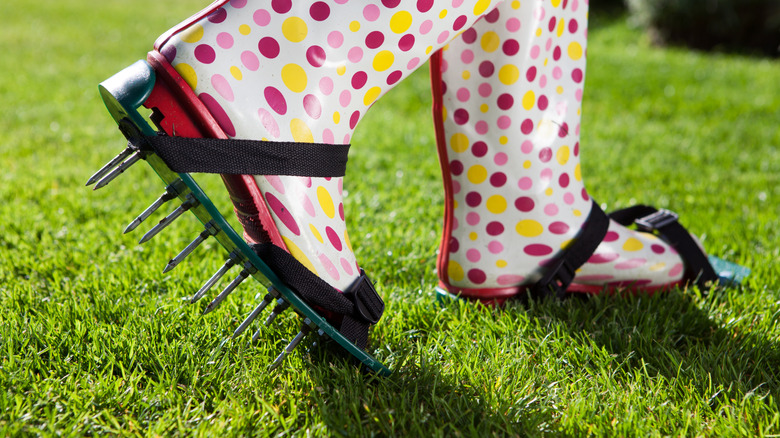
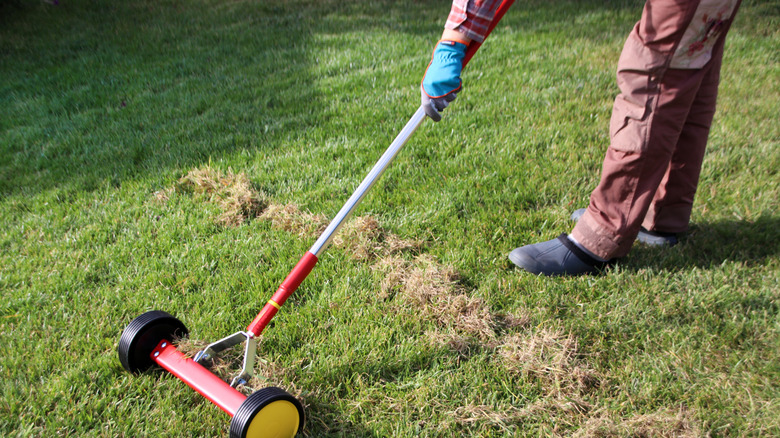
How you dethatch your lawn typically depends on the size. If you have a large lawn, you'll probably want to use a power dethatcher, but for small lawns, you can do the job with a dethatching rake. Either way, it's important to rake up debris from the lawn when you're done. Aerators (whether you buy one or DIY an aerating tool) typically come in two varieties: spike and core. Spike aerators are easy to use, but they aren't very effective, because the spikes just push dirt aside and compact it more. A core aerator, on the other hand, removes a plug of dirt and deposits it on the surface. This creates lots of space for air to circulate and water to flow.
Both of these procedures are like surgery for your lawn, so it needs time (from two to four weeks) to recover. You can overseed during this period, or you can wait until after to see how much of the lawn needs it.