

The Simple Way To Fix Your Patchy Lawn And Prevent Weeds From Taking Over
We may receive a commission on purchases made from links.
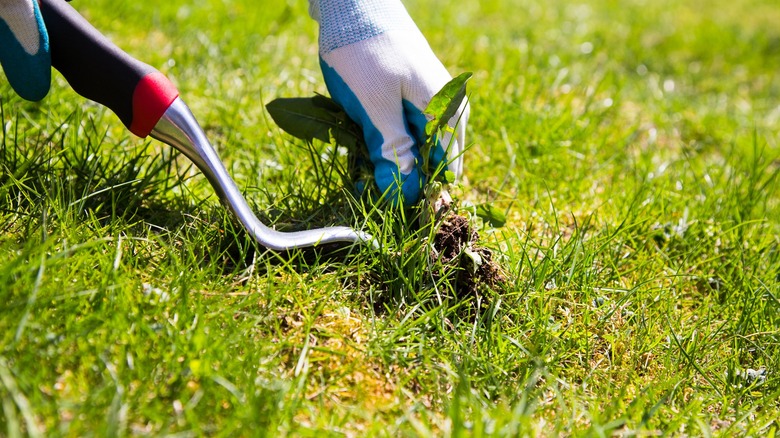
Weeds are not necessarily ugly or useless. Some people even grow dandelions for salads and teas. They're only considered weeds when they're growing in places they aren't wanted. If that happens to be in your lawn, there's an easy way to control them: overseeding. At the same time, this technique helps restore a patchy lawn to looking lush and green.
Overseeding your lawn means to sow seed directly over existing grass, rather than on a bare block of earth. As the new grass sprouts and becomes established, it fixes the ugly brown patches or bare spots to which many lawns are prone, and that's bad for weeds. They like to grow in these nutrient-rich patches, but the new grass outcompetes them. Essentially the denser your lawn, the harder it is for weeds to grow. Besides dandelions, overseeding helps control several common annual and perennial weeds including crabgrass, chickweed, and others.
Your lawn may have developed patchiness for several reasons: It may be underwatered, you may be mowing it too short, you might have a subsurface grub infestation, or too many people may be walking on it. It's also possible that the soil has gotten compacted, or a layer of thatch has developed that basically smothers the grass growing underneath it. Be aware that you'll need to address these root issues if you want overseeding to succeed.
How to get great results by overseeding
You have to sow new grass seed at the right time if you want it to germinate. That's usually in late summer or early fall, when the soil is still warm enough, and moisture conditions are right. Early spring is also good, as long as you don't wait for the weather to turn hot. Be sure to get a seed mixture that's right for your climate zone. Your local garden center can help you choose one.
If you don't collect your grass cuttings when you mow, your lawn has probably developed a thick layer of thatch, and it will prevent new seed from falling to the earth and sprouting. You need to de-thatch the lawn, using a manual thatching rake for small areas or a power rake for large ones. You should also aerate the soil. There are gardener's tools for doing this, but if you don't have one, a simple DIY lawn aeration trick is to use a cordless drill and a 3/4-inch drill bit. Focus on patchy areas where the soil is particularly compacted, covering the holes with a loose layer or topsoil when you're done.
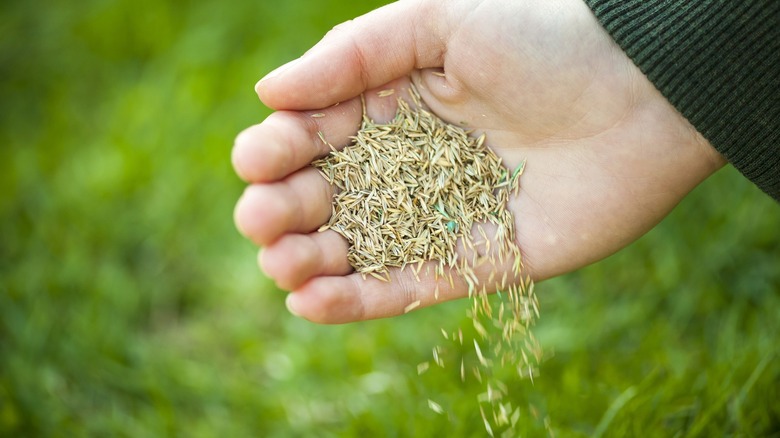
Spread the seed by hand if you're covering patches or small areas (similar to how you might seed divots on a golf course). To reseed an entire lawn, it's better to use a spreader, like the Scotts Whirl hand-powered spreader, which will overseed up to 1,500 square feet on a single bucketful. Water heavily immediately after reseeding and continue light watering daily until the new grass sprouts.