

Here's How Many Solar Panels You Need To Fully Power Your Home

Keeping the lights on is getting mighty pricey. In the last year alone, average residential electricity prices per kilowatt-hour (kWh) shot up more than 6% according to data from the Energy Information Administration (thanks in part to new data centers driving up the cost of your utilities). If you're tired of sticker shock when you open your electricity bill, it may be time to go solar. But the burning question that arises when you're planning the switch is, how many solar panels do I need to fully power my home? The real answer is that it depends on your energy consumption, where you live, and the panels you choose. But the magic number for the average American home is just under 20 solar panels.
Magic numbers need magic formulas, and fortunately, there is one. The formula to calculate how many solar panels you need is as follows: annual energy consumption (in kWh), divided by production ratio (mostly determined by how much sunshine you get), divided by panel wattage. Those three numbers divided in order will tell you almost exactly how many solar panels your home will need.
Here's a handy example with a lot of averages! Let's say you live in an average American household consuming an average 10,500 kWh of electricity per year, and you live in an area with an average amount of sunshine (1.4 production ratio), and you decide to buy panels with an average 430-watt power rating. 10,500 divided by 1.4 divided by 430 equals 17.44. Round up and you get the magic number of 18 solar panels needed by the most average of average American homes.
Going beyond the averages and applying the 20% rule
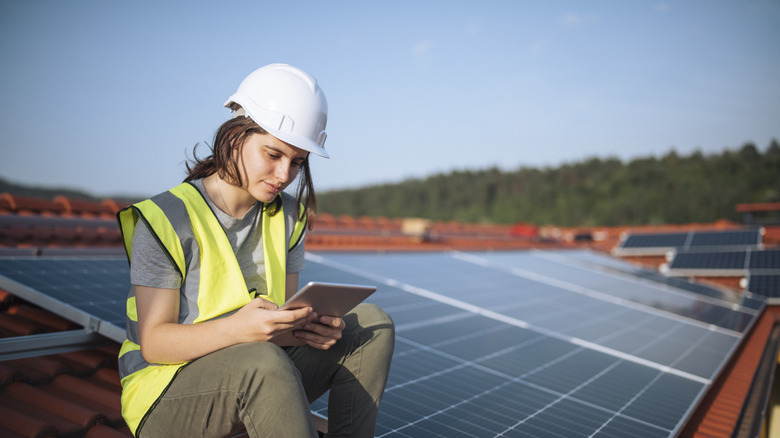
Okay, magic numbers are great. But what if your household is not so average as the example above? Let's go to the extremes to demonstrate how many panels you might conceivably need. You consume 16,000 kWh of electricity per year, which is, to say the least, a lot of juice when you're trying to save money on your electric bill. You live in the Northeast or Pacific Northwest, say Massachusetts or Washington, with very little sunshine and so a production ratio of just 1. To top it off, you choose to buy solar panels with a measly 320 watts of power output each. 16,000 divided by 1 divided by 320 equals 50. In this worst-case scenario, you would need 50 panels to adequately power your home.
But wait, there's more good news to brighten up your solar plans. Solar industry guidelines recommend you design your system to provide at least 20% more electricity than you typically consume. The 20% rule provides you with a safety margin to weather hot summers and cold winters when your energy consumption will probably spike. So, even in the average case of 18 panels, you should budget for 22.
Now that you know the magic formula, it's time to crunch your specific numbers. To figure out your annual energy consumption, check your energy bills for the last year. It's important you get a full year of records to capture all the highs and lows. To figure out your production ratio, which determines how efficient your solar panels will be, talk to a local solar panel installer or check this chart (via EnergySage). Wattage is up to you, but most solar panels sold today provide between 400 and 460 watts of power output. Divide in order, add 20% to be on the safe side, and you'll know exactly how many solar panels you need to fully power your home.