

Move Over, Lenox — The Valuable Porcelain China Brand To Search For At Thrift Stores

We may receive a commission on purchases made from links.
There are a few big names in porcelain, companies that have been producing pretty plates and other dishware for centuries. In the U.S., Lenox is a biggie, dating to 1889 and known for its cream-colored dishware and hand-painted designs. Over across the pond, there's Wedgwood, founded in 1759, and celebrated for its iconic vintage Quince dishes. And in southwest central France, there's Limoges, a city rife with beautiful ceramic works.
In a city full of porcelain, one brand reigns supreme — Royal Limoges. Founded in 1797 in its namesake city, the company was family run for generations, until it was purchased by Émile Gérard, Jules Dufraisseix, and Edgar Abbot at the end of the 19th century. Taking on the name G.D.A., the brand became celebrated for its pieces in the Art Deco and Art Nouveau styles. By the 1930s, it was the largest porcelain producer in Limoges, employing more than 1,200 people and expanding its reach across the Atlantic, selling its wares to the U.S. as well as in France.
Near the end of the 20th century, in 1989, G.D.A. changed its name to Royal Limoges, reflecting the company's history (it was once under the control of Louis XVI's brother), and its status as one of the region's most celebrated porcelain brands. While porcelain may have fallen out of favor once, antique and vintage China is making a comeback, making Royal Limoges worth keeping an eye out for.
Searching for Royal Limoges
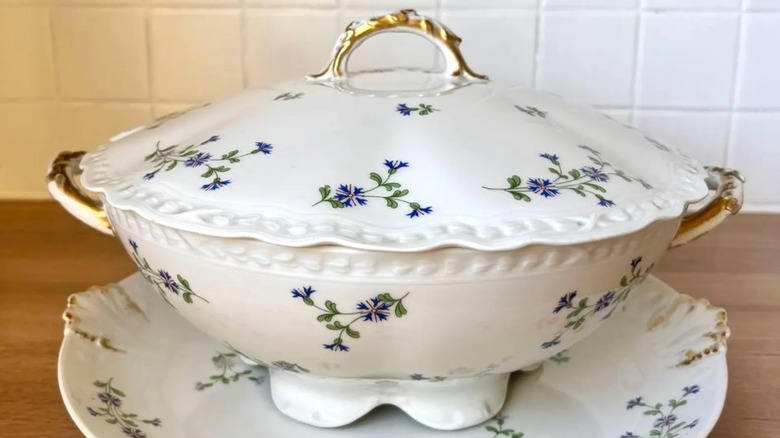
Finding Royal Limoges or G.D.A. porcelain can feel a bit like finding a needle in a haystack. Or, more accurately, an intricately designed and painted piece of porcelain in a sea of porcelain. That's because the description "Limoges" isn't limited to Royal Limoges or its predecessors. Limoges is a UNESCO Creative City and the capital of ceramic arts in France. Simply put, there are a lot of companies that produce or have produced pretty porcelain over the years, all bearing the mark of Limoges, and in some cases, Royal Limoges.
To identify antique dishes, flip them over — there should be some sort of mark indicating the company and place of manufacture. For instance, pieces made by Royal Limoges when it was operating as G.D.A. will have a stamp that reads "GDA Limoges" on the back or underside. Later pieces will read "Royal Limoges." Pieces that weren't made by G.D.A. and come from Limoges will read "Limoges France" on the back and may have the name of another manufacturer.
Now, here's where it gets tricky — really old pieces are likely to have "Royal Limoges" stamped on the back. But, these weren't necessarily made by the company currently doing business as Royal Limoges. Still, it's those really old pieces that have the most value. Depending on the style, age, and condition, some antique Royal Limoges dishes can cost several hundred to more than $1,000.