

Forget Pyrex: The Ultra-Rare Vintage Soup Bowl You'd Be Thrilled To Find At A Thrift Store

We may receive a commission on purchases made from links.
Those old iconic serving pieces add something special to mealtimes and are a perfect way to dress up your table settings. While authentic vintage Pyrex always seems to get all the attention, the Fiesta covered onion soup bowl is a treasure that many collectors would be thrilled to find at a local thrift store. The company's story begins in the late 19th century with the founding of the Homer Laughlin China Company. Established in East Liverpool, Ohio, the company started making pottery with just two kilns, eventually expanding operations to include seven different plants in 1927. For over 50 years, the company produced the same pottery lines but eventually decided they needed a change. They hired ceramist Frederick Hurten Rhead, who created the iconic Fiesta pattern.
The original 34-piece dinnerware set was available in yellow, cobalt blue, light green, old ivory, and red. The covered onion soup bowl was part of the original set. It had a round body, small side handles, and a domed lid. It was one of the least popular pieces in the set, so the company limited production to just a year. Because of the short run, it's now one of the most sought-after and valuable pieces, often bringing as much as $1,000 online.
In 1937, the company produced a brand-new turquoise color. Only a few dozen of these bowls were made before it was discontinued, making it one of the rarest of vintage dishware thrift shoppers can't resist. Today, this bowl goes for as much as $7,000 to $9,000 at auction in pristine condition. If you can find one with chips and missing lids, they sell for as much as $1,000.
Identifying authentic Fiestaware onion soup bowls at the thrift store
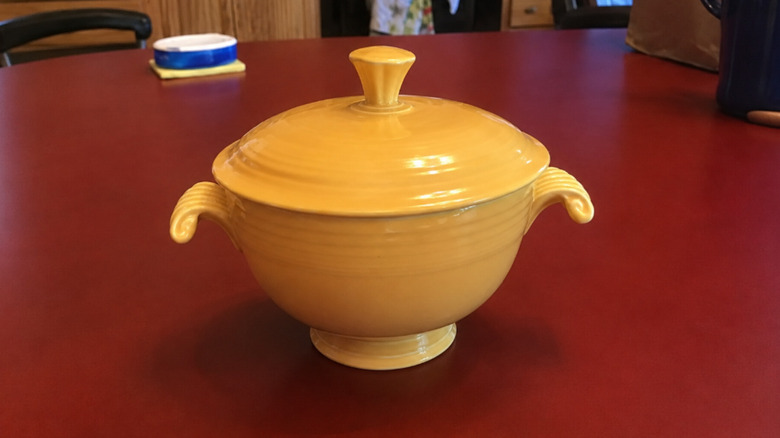
If you're lucky enough to spot one of these super rare onion soup bowls out in the wild, you'll want to know whether you're looking at an original Fiesta piece. Fortunately, there's an easy way to do this. Flip the bowl over and look at the maker's mark. The Fiesta backstamp can tell you a lot about when the bowl was made.
Bowls produced between 1936 and 1973 will have an ink stamp with the word Fiesta in all lowercase letters. You'll also notice the initials "HLC," which stand for Homer Laughlin China. The mark will also include "USA," which indicates where the pottery was made. If the first letter of Fiesta is capitalized, the piece was produced after 1986.
Aside from the mark, pay attention to how the bowl feels. Vintage Fiesta is thinner and feels lighter than newer pieces because they were made with a semi-vitreous clay body, which is more porous and less dense than modern dishes. You'll also want to examine the body of the dish. It's not uncommon to see an uneven glaze with tiny pinholes. Don't mistake this for damage. These little imperfections are actually part of the vintage firing process.