

No Need For Tools: Sharpen Blades With A Dish That's Already In Your Cabinets
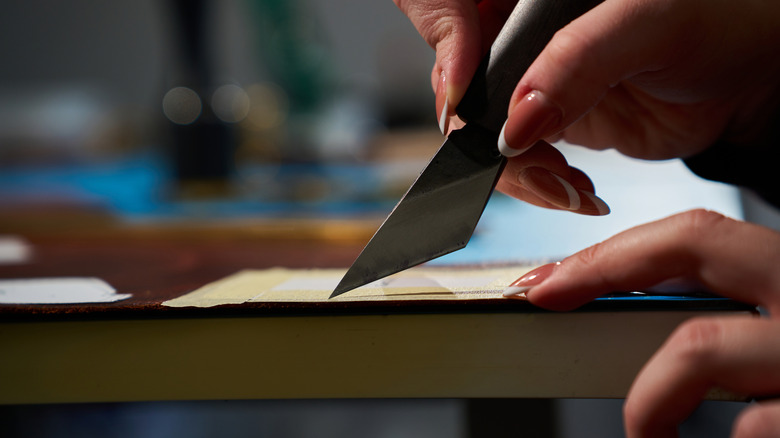
Is there anything worse than using a dull utility blade when you're almost done with a DIY project, or a neglected kitchen knife when you're trying to cook a meal? Not only is it infinitely more difficult to make precise cuts, but since you have to apply more pressure and use more force with a blunt knife, it's also way more dangerous. While the sharpening process is easy if you have a whetstone, grinder, or purpose-built electric device, you may find yourself at a loss if none of those tools are at your immediate disposal. It turns out there's actually no need for tools. Because glazed ceramic coffee cups, plates, or bowls usually have a slightly abrasive underside, you can easily sharpen blades with a dish that's already in your cabinets.
Sharpening kitchen knives is one of those things a lot of us put off because it can feel intimidating. The same goes for landscaping or utility blades that seem either too big and bulky or small and fiddly to sharpen safely. But the unglazed ring around a ceramic dish is ideal for the task because it provides a flat and stable surface along with just the right amount of abrasion to restore the edges of a dull blade. If you're struggling with dull blades, here's how to substitute a simple ceramic dish for a traditional whetstone.
How to sharpen a knife with a ceramic mug or plate
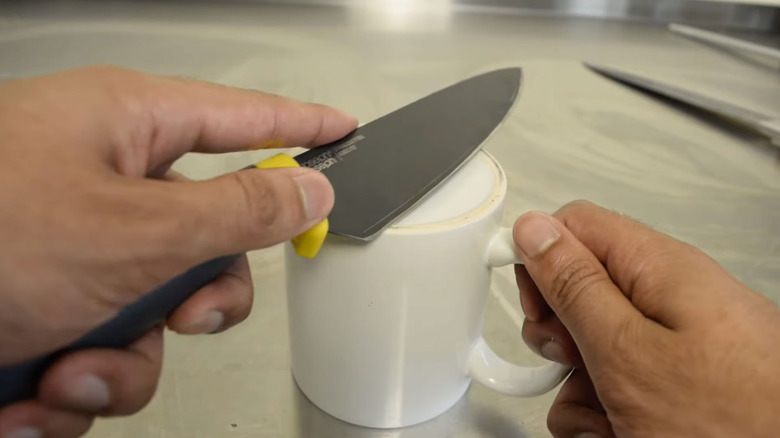
Over time, using blades rounds the edge where both sides meet. The goal with sharpening is to straighten each side back out until it meets the other at a microscopic point. Making several consistent strokes at the same angle with evenly applied pressure is the key.
The first step is placing your ceramic mug or plate with the unglazed side up on a flat surface. Lightly dampen it before making your first sharpening pass. Then, working at a 20-degree angle, run the entire edge of your knife along the gritty ceramic ring. Re-moisten the unglazed ring before repeating the process on the other side. Continue this process for several passes on each side before checking for the burr, a small ridge that will form along the opposite edge of the side you're sharpening as you work. Alternating sides helps you develop and shift the burr across the blade to ensure you've sharpened the entire edge. The final step is to run your knife gently along a leather belt at a very low angle to smooth the burrs out. Finally, test your newly sharpened blade on anything from a piece of paper to a ripe tomato.
Simple ceramic plates or mugs are just one of the secrets to sharpening dull knives already hiding around the house. You can also use this technique with a piece of aluminum foil from your kitchen pantry or a nail file hiding in the back of your bathroom cupboard. But no matter which method you chose, both dull and sharp knives should always be handled with extreme care to avoid serious injuries.