

Turn A Wire Fence Into Instant Backyard Privacy With An Easy DIY
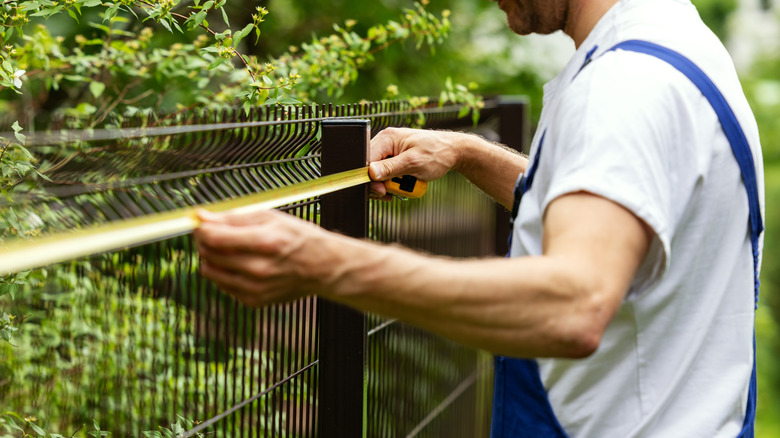
While yard fencing is installed for any number of reasons, from keeping the dog in to creating child safety boundaries, one of the main motivations is privacy. Good fences make good neighbors, as they say! But what if your home has a basic wire fence that provides containment but no privacy through its open grid? Thankfully, TikTok's here to save the day without breaking the bank, with user thediyguy1 sharing how to add privacy to a standard, wire mesh fence by simply sliding wood slats within the grid.
The basic idea is to use wood boards to create a frame surrounding on one side of the wire, then affix vertical strips between the upper and lower supports on the opposite side of the wire to secure everything together. This hack will work with any type of welded wire fencing, whether it's a flat grid or has the curved profile. The curved fencing panels, called 3D curved wire, in the TikTok video give the fence additional bracing and stability against wind or wear and tear, because the wood slats slide between the wires.
You'll want to use wood slats made from material that will withstand the elements, such as cedar or pressure-treated boards. Measure the overall length and height so you can calculate how much wood is required, as well as the best board lengths to purchase for your particular fence dimensions. You'll need horizontal boards that run along the top and bottom, and vertical slats that run between them for the entire length of the fence. Once the materials are calculated and in hand, it takes only an afternoon and some basic tools, like a staple gun, to transform your basic wire fence into a DIY privacy fence.
How to add privacy to a wire grid fence
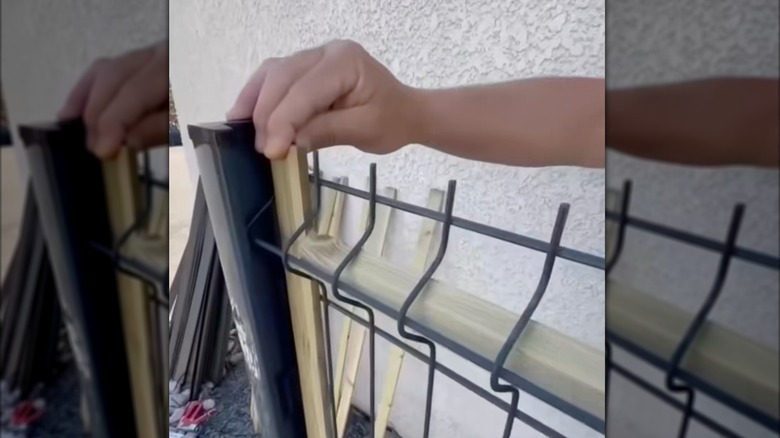
To create your own privacy fence out of an open wire grid, begin by attaching the horizontal bottom and top wood rails to the fence. For 3D curved fences, simply slide them into the curved sections at the top and base. Then, insert your outer vertical supports into the column created by the curve, and secure it to the horizontal rails.
For flat wire fencing, you have two options for building the outer structure. You can construct all four sides of the frame on the ground before lifting it into place and using the inner vertical slats on the opposite side of the wire to hold everything together. Or, for a more secure frame, configure it so that the bottom and top rails are on one side of the wire fence, while the outer vertical supports are on the other (or both sides) and attached very securely with screws or brackets. By surrounding the wire mesh with the frame, the whole thing feels firmly secured to the fence.
@thediyguy1 This Fence Hack Gives You Instant Privacy for Almost Nothing! #FenceHack #DIYProject #BackyardUpgrade #HomeImprovement #PrivacyFence
Once the outer frame is built, it's time to install the vertical privacy slats. For the 3D curved fence, it's as simple as sliding a slat into every vertical column and attaching it to the horizontal rails. The TikToker used a staple gun, but brad nails or screws provide extra support as needed. For flat grid fencing, typically your only option is to run the vertical slats on the opposite side of the wire, as opposed to the outer frame, and secure them. But if the wire has some give, you may be able to slide the top and bottom of the slats (or completely weave the slat) through the wire grid for added support. After all your hard work, not only will you have newfound privacy, but you'll want to research if a fence boosts your home's value.