

Does White Vinegar Kill Bacteria?
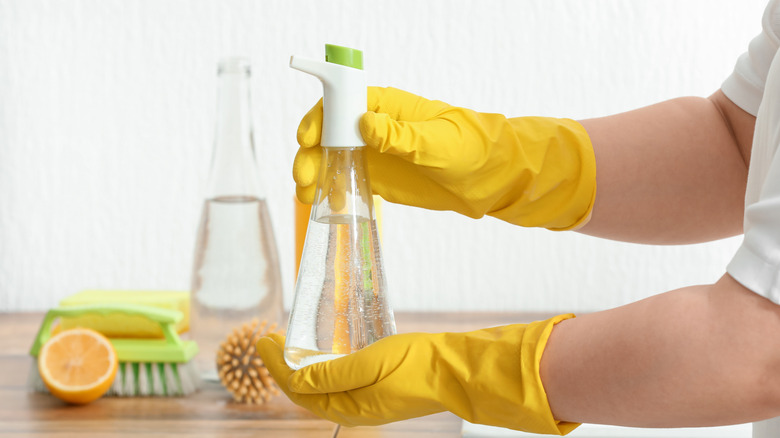
In the world of "green" or DIY cleaning recipes, you might have noticed that many of them call for distilled white vinegar. There happens to be good reason for this. White vinegar not only helps to break down alkaline messes around your home, but it also happens to have antimicrobial properties. In other words, it does have the ability to kill some bacteria around your home. Before you toss out all your chemical disinfectant products, though, it's important to know that while white vinegar can kill some forms of bacteria, it does not get rid of all types of pathogens.
The same white vinegar you might use for certain food prep and cooking tasks contains the key active ingredient acetic acid. Different types of vinegar also contain acetic acid in varying concentrations, which is what makes cleaning vinegar different from white vinegar. Regular distilled white vinegar has a 5% acetic acid content, which is enough to kill certain microorganisms, such as salmonella and E. coli. In this way, white vinegar may act similarly to disinfectants you might buy from a cleaning aisle at the store.
One study published in Scientifica in 2025 also noted the efficacy of acetic acid. Here, researchers collected samples of bacteria from patient areas in a hospital and found that acetic acid helped kill both gram-negative and gram-positive strains of bacteria just as well as disinfectants. They go on to note that the safety, efficacy, affordability, and accessibility of acetic acid-containing products makes them worth considering in certain cleaning situations. However, white vinegar may be among the products that do not fully disinfect your home.
Limitations and caveats with using white vinegar as a disinfectant
White vinegar can indeed be considered a disinfectant, but not in the same way as commercial products. One big limitation is that, while acetic acid may kill several types of bacteria, it cannot kill viruses and fungi compared with recognized biocides, such as alcohol and hydrogen peroxide. Plus, according to the Centers for Disease Control and Prevention, disinfectants include bleach or other commercial products registered with the Environmental Protection Agency. White vinegar is not a registered disinfectant, and should not be regarded in the exact same way.
This doesn't mean you cannot use white vinegar to kill some germs, but you may need to occasionally use commercial products for getting rid of other microorganisms. One notable example is if someone in your home has a viral infection, as white vinegar simply won't kill these types of germs on surfaces. While a BMC Microbiology study published in 2020 found that acetic acid (when combined with citric acid) may have virus-killing capabilities, the effective concentration was 10% — this is double the amount of acetic acid found in regular white vinegar.
If you are interested in using white vinegar, consider using it to make a DIY all-purpose cleaner. The Cornell Cooperative Extension recommends making a homemade vinegar cleaning solution by combining equal parts white vinegar and water in a clean spray bottle, and adding lemon juice to offset the strong smell. Always use white vinegar solutions in a well-ventilated room, and never use them on natural stone, wood, or aluminum surfaces, as well as electronic screens.