

The Best Porch Light Color That Won't Attract Bugs
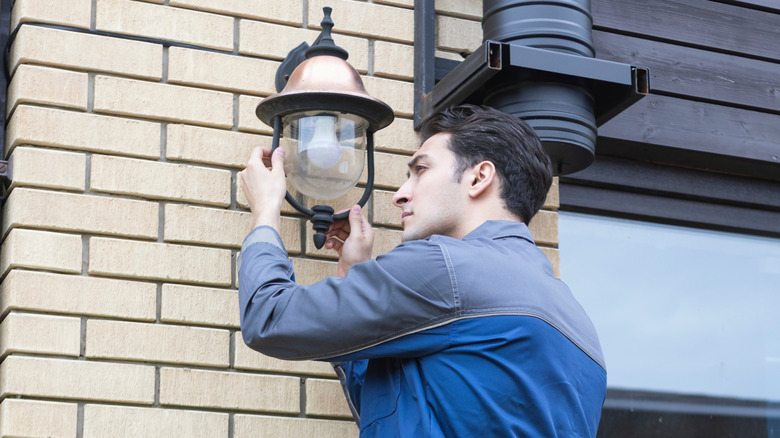
Colorful lights are a great way to brighten your porch during holidays and to show your support for your favorite team or various causes. For example, spooky black and orange lights enhance Halloween decor, while blue porch lights can be used to honor fallen police officers. However, with certain illumination, you may notice that leaving your porch lights on at night attracts numerous flying insects. If you're running into this situation, opting for LED lights in warm tones like yellow, orange, red, and amber can help, as they lure in fewer bugs.
Wondering why these creatures are biased toward certain light colors? Well, nocturnal insects like moths — along with flies and other bugs — use the light of the moon and stars as fixed navigation points, and bright lights may resemble the moon to them. Many insects are also drawn directly toward or away from light sources through phototaxis (this is why cockroaches scatter, yet moths are drawn in when you turn on the lights). Finally, many bugs and insects also see ultraviolet (UV) light, which we don't, reflected on flowers and other tempting targets.
As a result, the bright incandescent light emitted by white or blue-tinted bulbs, as well as other UV light sources — such as mercury lamps and fluorescent tubes — confuse and attract a whole host of insects and bugs that then circle your porch lights once the sun sets. Using warm colors in longer wavelengths like amber or yellow produces less energetic, often less intense light, and LEDs emit basically no UV light.
Using warm-tone LEDs attracts fewer bugs and fewer problems
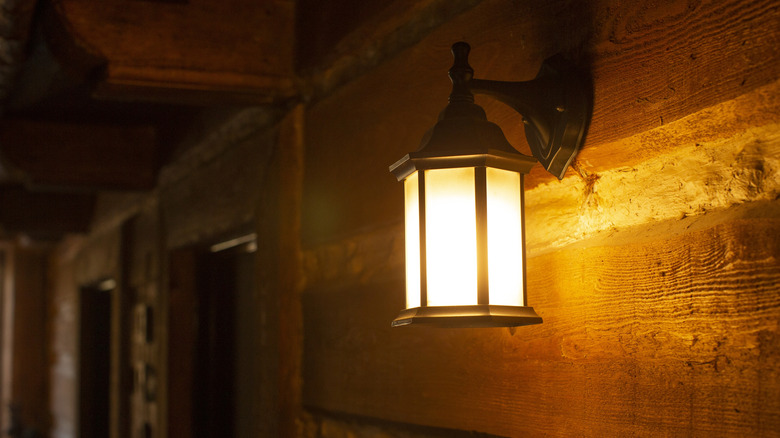
A joint research conducted in the Amazon River Basin (it being a hotspot for bugs) by UCLA and the Smithsonian Conservation Biology Institute analyzed the effect of artificial lights on insects and other species. It confirmed that yellow or amber LED lights attracted fewer bugs (some of which are crucial for pollination and local food chains) than white, blue, or UV-emitting versions due to their wavelength. This produced a whole host of benefits for humans and bugs alike.
Though these bugs might be annoying for you (biting insects are among those congregating), porch lights can be harmful to these species as well. An estimated one-third of insects attracted to lights die as a result. Some deaths are due to dehydration and extreme exhaustion as bugs endlessly circle the light source rather than following their daily routines. Others trapped at these lights become dinner for savvy predators such as spiders and bats.
The research study also found that usage of artificial lighting at night should be limited. This doesn't just help keep bugs away but also won't attract or confuse other creatures like sea turtles, frogs, and others, who operate at night, by the stars and the moon. However, if you want to keep outdoor lights on for security or work reasons, switching over to smart lighting systems is one answer. You can seamlessly incorporate them with your smart home assistant as well as set timers for them to turn on and off at specific times as needed and where needed.