

50 Years Later, This Essential Household Appliance Looks Totally Different

You reach for that bowl of popcorn but it comes tumbling town onto your living room rug. Cleaning carpets may be the most hated chore in America, but there's no denying that vacuums have completely transformed how we rid our homes of everything from crumbs to cobwebs. 50 years after Kirby and Electrolux door-to-door salesmen were making their persuasive visits, this essential household appliance looks totally different as robot vacuums are taking over the dreaded task altogether.
The earliest carpet cleaners were introduced nearly two centuries ago, in the form of rotary mechanical sweepers popularized by Melville and Anna Bissell. A few decades later, after placing a cloth over his mouth and attempting to suck the dust off upholstered furniture (yes, really), British engineer Hubert Cecil Booth patented the first vacuum cleaner. And inspired by that stroke of genius, an asthmatic janitor combined a ceiling fan motor, a pillowcase, and a chance meeting with William Hoover to create the world's first electric vacuum.
In the decades that followed, homeowners would embrace lightweight vacuum designs made of Bakelite, convertible options in bright retro colors, automatic speed selectors, and turbo brushes. Disposable dust bags eventually gave way to bagless cyclonic contraptions. For decades, the must-have cleaning machine required a near-ritual experience of pulling or unwinding a soon-to-be tangled cord, lugging a loud and heavy machine around the house, and breathing the occasional-yet-unavoidable billowing cloud of dust. In recent years, lightweight cordless models and the addition of HEPA filters freed homeowners from some of those hassles. But today, robot vacuums are practically doing the job without us.
How vacuums have evolved since the 1970s
Long after those enormous, early versions were pulled around town via horse and buggy, upright and canister vacuums became essential household appliances by the 1970s. Several post-war era factors played a role, from booming economic growth to advances in mass production. Along with the introduction of disposable dust bags, it was also around this same time that vacuums began to be equipped with HEPA filters. Originally developed as part of the Manhattan Project to trap particulate radiation, when the technology became declassified, it quickly made its way into residential cleaning.
This major advancement didn't satisfy Sir James Dyson, who famously became frustrated with the way in which clogged vacuum bags (disposable or not) would reduce suction over time. During the late 1970s, he began prototyping what would eventually become his eponymous invention, the world's first bagless vacuum. Meanwhile, Black & Decker began selling the first cordless handheld vacuum, the Dustbuster, which was embraced by millions of households during the 1980s thanks to its convenience and portability.
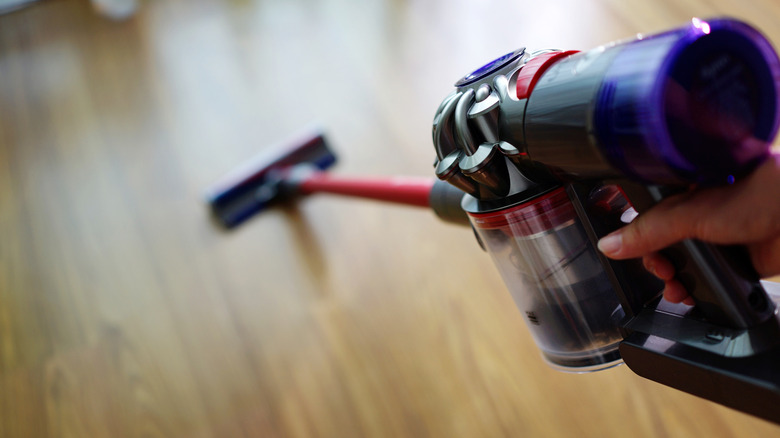
Once again, Dyson saw an opportunity to improve on the status quo. By the 2010s, his team embraced the advent of lithium ion batteries that could power highly efficient motors to create the first cordless stick vacuums. While there are plenty of reasons you may want to think twice before buying a cordless stick vacuum, today they account for nearly half of all vacuums sold in the United States thanks to technological improvements in battery life and runtime, multi-surface cleaning capabilities, and smart home integration with tools like Alexa.
Robot vacuums are here (for now)
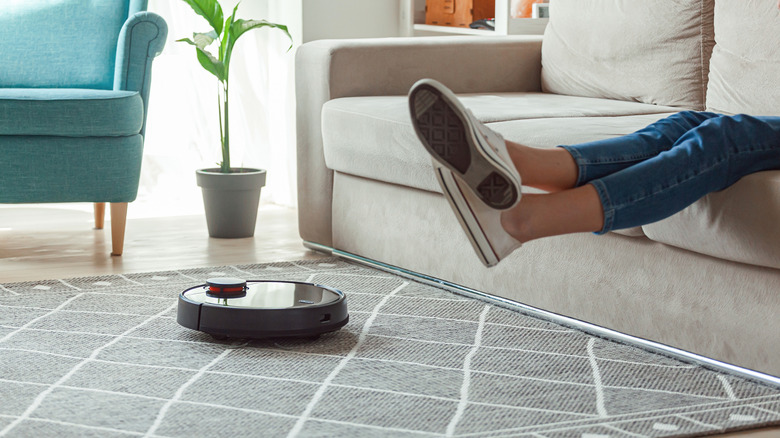
While it's safe to say most American families were introduced to robot vacuums thanks to "The Jetsons" in the 1960s, the first commercially successful option didn't arrive until nearly 50 years later. The Roomba was released in 2002, and parent company iRobot has since sold over 40 million of the autonomous cleaning units since. The technology behind the disc-shaped devices has continued to evolve. Robot vacuums typically rely on cameras and laser technology, known as Light Detection and Ranging (LiDAR), that help them map rooms while avoiding collisions with walls and stairs. Spinning brushes and suction combine to lift dirt and debris into internal collection bins that are easily emptied. And most robot vacuums are programmed to drive themselves back to a docking station when it's time to recharge the battery.
Today, Roomba isn't the only robot vacuum in town. Along with popular picks like iRobot and SharkNinja, manufacturers like LG, Samsung, and Dyson have added autonomous models to their product lineups. As smart home technology continues to advance, experts believe they'll continue to take over our least favorite chore.
However, it might become harder to buy a new robot vacuum after the recent U.S. ban. In July 2026, the Federal Communications Commission (FCC) announced that advanced robotics systems produced in foreign countries, like those found in high-tech, whole-home vacuums could create cybersecurity risks for Americans. The ban doesn't impact homeowners who've already purchased a robot vacuum, and manufacturers can keep selling models that are on the FCC's approved list. The move may even motivate future robot vacuums to be more privacy-aware, which is good news for homeowners who don't want to broadcast how dirty their floors can get!