

Handy Tools For Removing Grass From Your Lawn Mower Blades And Deck
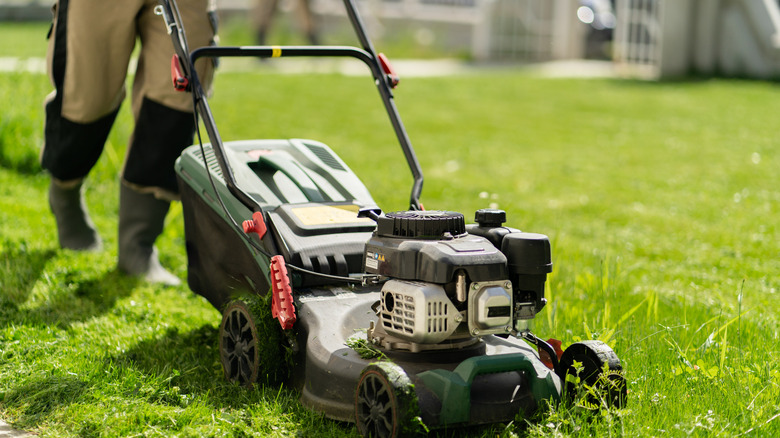
Keeping your lawn neat and tidy is much easier with a mower that's in top condition. One of the top lawn mower maintenance tips is to clean your lawn mower, which includes removing grass from the blades and deck. Stuck-on grass can lead to uneven cuts and performance issues with your mower, so it's important to get rid of it as often as you can. However, the blades and underside of the mower deck aren't the most convenient places to reach, plus grass that's dried in place can be a pain to knock loose. That's why tools like putty knives and condensed air sprayers are so useful.
Blades of grass on their own are fairly weak and easy for your mower to deal with, but clumps can seriously gum up the works. Your lawn mower is designed with precision, so any extra material can throw everything off. The grass clumps can block air from flowing properly, leaving more grass clippings in the way. Although grass doesn't weigh much, the added weight can make the blades unbalanced, slowing them down and making your mower work harder to compensate. The end result is a mower that needs more regular refueling, breaks down faster, and leaves uncut patches of grass, giving your lawn a rough, uneven look. Additionally, the moisture in the grass can lead to rust forming on your mower. If you aren't regularly cleaning and checking your blades and deck, this rust could go unnoticed, which is why cleaning can extend your lawn mower's life.
The simplest tools
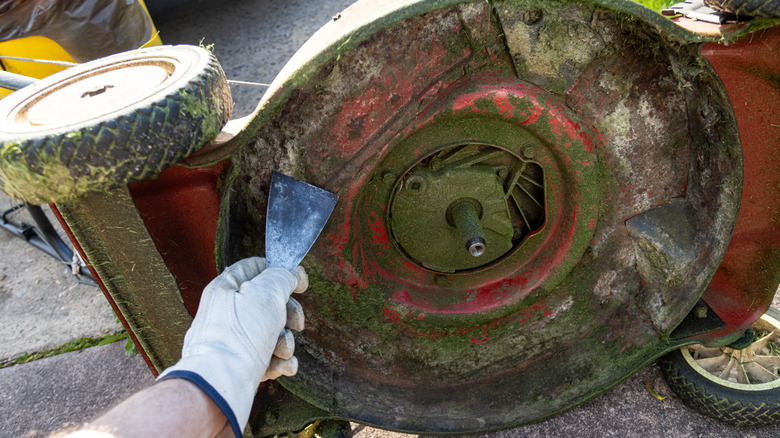
The simplest way to remove grass from your lawn mower deck or blades is by physically scraping it off. Using a plastic scraper such as a putty knife, ice scraper, or a scraping tool specially designed for use on lawn mowers will work. They can be used to get rid of large chunks of built up grass clippings or smaller streaks of individual blades of grass. Some people also find success with improvised scrapers like paint stirring sticks, grill brushes, or even spatulas. However, keep in mind that anything not designed for scraping may not hold up as well under heavy use or may cause additional frustration if the shape or size isn't quite right. In addition to scraping, brushing can also work. A stiff-bristled brush designed for scrubbing or a handheld broom is ideal, as they'll hold up against tough grass clumps better than something designed for lighter use.
If there's only a small amount of grass and dust stuck to your lawn mower blades and deck, you may only need a rag or cloth. A little bit of soap and water on a rag can help soften and clean dried bits, while a dry rag is useful for cleaning off any dust or leftover grass shreds that were knocked loose but not fully removed. Plus, using a dry cloth can get rid of any moisture left behind by the grass, which is helpful for preventing rust.
More specialized tools
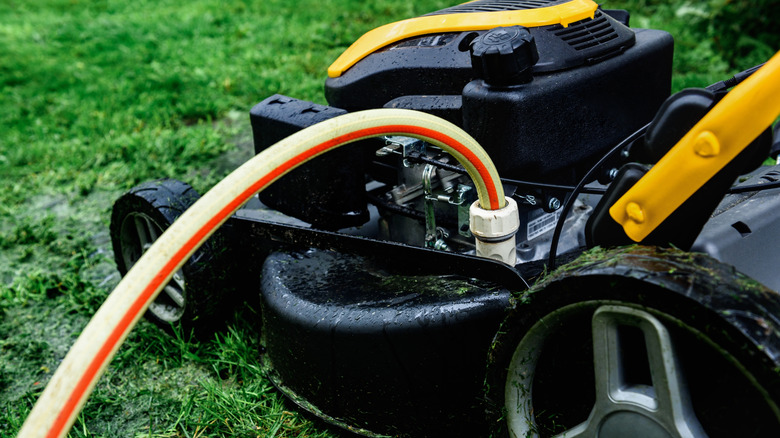
Compressed air sprayers and water hoses are both more specialized options for removing grass. You can power wash your lawn mower deck and some mowers may even have a wash port designed for use with hoses. You do need to take care not to get any electrical elements wet, however. Air and water are particularly helpful if you have grass stuck in hard to reach corners of the lawn mower deck or if the grass is stuck too firmly for you to remove by hand. The force of the air or a brief dampening in water can help loosen it. Compressed air sprayers and water spraying devices may also be useful if you have physical limitations that prevent you from scraping, lifting, or crouching. Since they typically have longer nozzles, they're easier to use from a distance, meaning you may be able to sit or stand while cleaning your mower.
Another option is to use a needle scaler to get into those hard to reach spots, and potentially to speed up the process. Needle scalers are a series of thin metal rods that vibrate at a high speed. They're typically used to clean surfaces of rust, paint, and similar coatings, but they can also remove clumps of grass and mud that have gathered on your lawn mower deck. If you haven't cleaned it in a while and have large amounts of build up that would be difficult to scrape off, a needle scaler may be able to cut through it with less effort.