

Skip The Hose: There's A Smarter Way To Clean Your Lawn Mower Deck
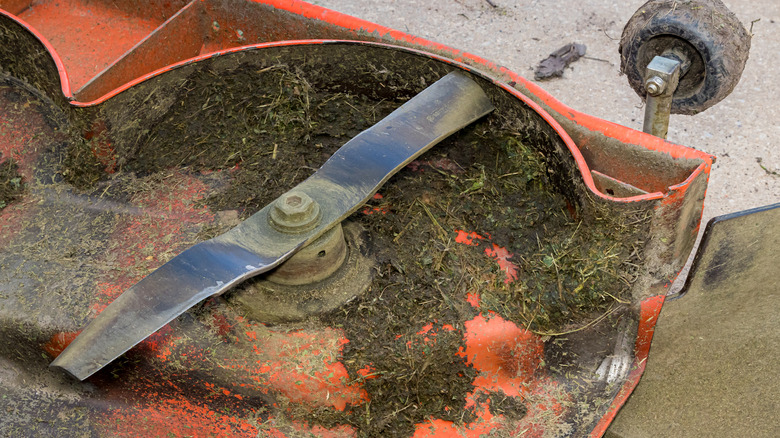
The business end of a lawn mower instinctively feels like a no man's land in which things get done, but in a zone we'd rather steer clear of .... something like a 19th-century dockyard or a Chicago meat-packing facility. But if we really want our grass healthy and looking nice, we occasionally need to get under there to keep things working smoothly. That means occasional blade-sharpening. It also means clearing the mower deck of grass clippings, ideally every time the mower is used. If you want the cleanup to be quick and easy, a pressure washer is the way to go.
Is this overkill? It's just grass, after all. But it's grass that's been severed and thrown at the mower deck at 200 miles per hour. It clumps and clings in wet sheets that hold moisture against the steel deck, looking for any scratch or chip in the paint to start a little rust factory. If you let this happen long enough, eventually you have less mower deck than you'd prefer.
Mowers often come with optimistic little wash ports in which you quick-connect a hose, start the mower, and sling water around in hopes of cleaning up some of the clumped grass. But most people find that household water pressure or the haphazard flinging of water droplets by mower blades don't really get the job done. Most mower manufacturers urge owners to avoid pressure washers, but some admit that it's the best tool for yard debris, especially if it's been allowed to build up over multiple mowings.
The best practices for pressure washing your mower deck
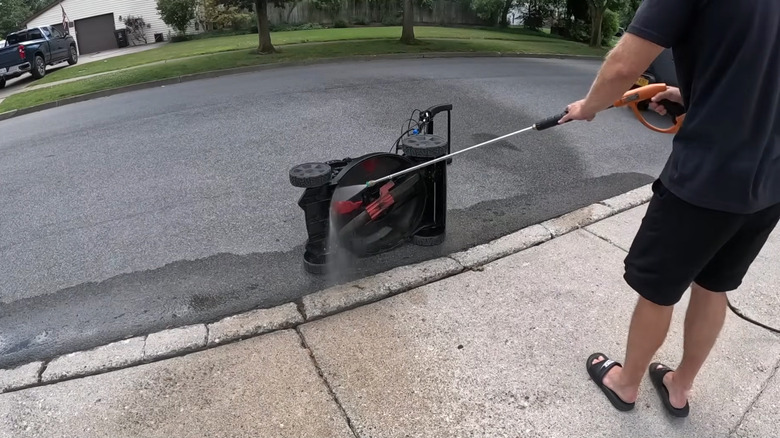
Aside from momentary pressure spikes or stuff that only happens when a hose is turned off, the best household water pressure you can expect is 45-80 psi. Many users agree that this isn't usually enough to clean crusty grass fiber mat off of a mower deck, and that a pressure washer makes quicker work of the task, at least occasionally. You don't want to go at a mower deck full-force with an industrial-strength water pressure, though, so choose your pressure washer wisely. Most users recommend a middling pressure of around 2,000-2,800 psi, the amount of pressure you'd apply to siding or a deck that you're cleaning.
Most pressure washers come with a range of nozzles that are color-coded to indicate their angle of attack and the resulting water pressure they can apply. For a powerful pressure washer, red and yellow nozzles are likely to be too powerful for a mower deck, and a green (25-degree) nozzle falls near the middle of the washer's range. Some swear by hose or pressure washer attachments designed specifically for the demands of mower decks, like the Ballard Pro/Blaster power washer attachment.
Consult your pressure washer's documentation for details specific to your model. It's often a good idea to put some distance between your sprayer and your mower deck when doing your lawn mower tune-up and maintenance routine, typically six to eight inches at a consistent rate. But if this were a universally good idea, of course, mower manufacturers wouldn't advise against it, right?
What can go wrong when pressure washing a mower deck
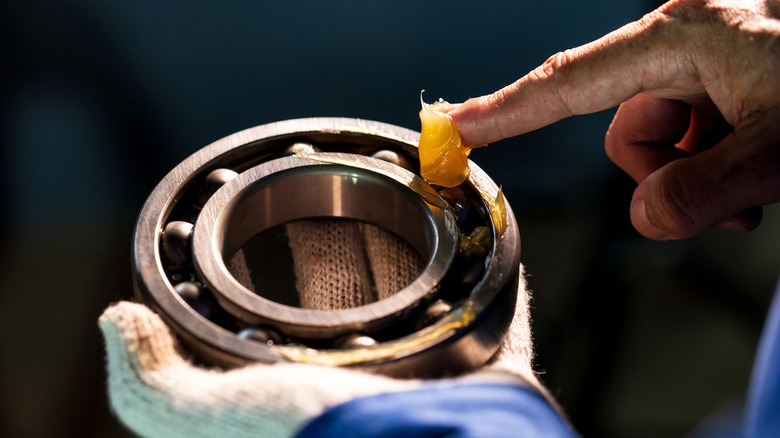
Whatever the motivations of the manufacturers (or their lawyers), there are definitely some problems that pressure-washing carelessly can cause your mower. Too much pressure can actually strip paint off the deck and leave it vulnerable to rust. Additionally, while your target might be the mower deck, there are plenty of parts on a push or riding mower that don't need water blasted into their workings. This includes some critical bits attached to the deck itself, especially the spindle bearings that let blades turn smoothly. Bearings rely on the lubrication of grease to allow things to rotate freely. Sealed bearings help retain this grease, but they aren't waterproof, and moisture can contaminate the grease. Most sealed modern mower deck bearings are not designed to be routinely repacked with grease, so avoiding frequent direct pressure-washer spray at spindle bearings is generally best.
There are other mower parts that don't get along with water as well, like carburetors, air filters, electrical, and sometimes electronic components (and, no, it's not a good idea to get rain in a lawn mower engine, either). In fact, it's probably a good idea to clean the top of a mower deck with compressed air or a leaf blower to avoid the sensitive bits. When you do use a hose or pressure washer, let everything dry before putting it away or using it again, to avoid rust and slipping belts.