

Paper Wasp Nests Look Different: Here's How To Identify One In Your Yard
Coming across a potential wasp nest can be unsettling, particularly if you don't know whether it poses any danger to you and your family. Social wasps are among the most aggressive species, and these include hornets, yellowjackets, and paper wasps. Despite all three of these common wasp species grouped together in this category, they create distinct-looking nests from one another, and there are certainly different types of wasp nests you don't want in your yard. A paper wasp nest is best identified by its papery appearance, but you can also tell a suspected nest may belong to these insects based on its location and other features, too.
Paper wasp nests look distinctly different from those of hornets and yellowjackets. First, nests associated with bald-faced hornet nests are large, yet enclosed, gray structures that typically look like large eggs. European hornets, on the other hand, tend to build their nests inside concealed openings, such as hollowed trees, attics, and even old beehives. Yellowjacket nests may be constructed with grayish-brown paper covering the entrances, and are built in the ground or around shrubs, depending on the species. Paper wasps do not have covered openings you'd find with a yellowjacket nest or a baldfaced hornet's nest.
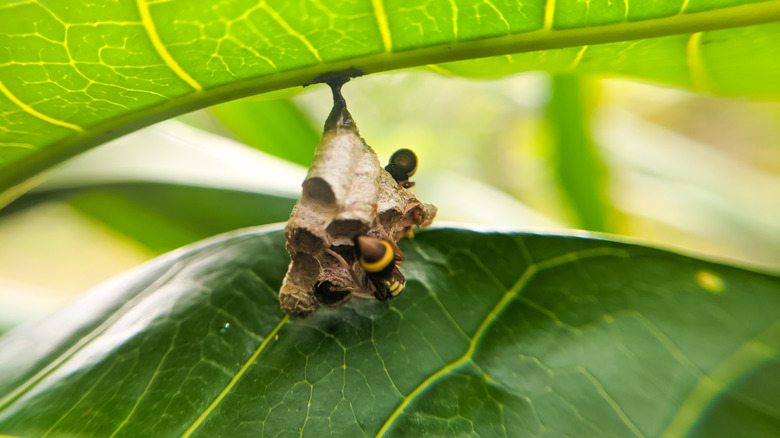
To make their nests, paper wasp workers first chew on tree bark, wood, and occasionally cloth fibers. These materials are then broken down into a pulp and eventual paper-like materials for nest construction. In this way, paper wasps are named for the very nests they build, which are grayish-brown, papery combs that are open-facing and appear as opened umbrellas that inevitably grow larger over the course of the nesting season.
Where paper wasps typically build their nests
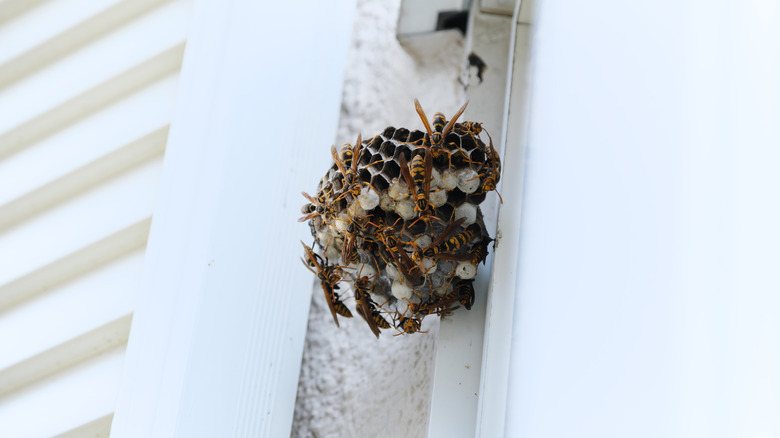
Location is another way you can tell a potential paper wasp nest apart from those of other social wasps. These tend to be built underneath flat horizontal surfaces, such as plant branches, as well as parts of human-made structures such as door frames, porch ceilings, eaves, and underneath railings. The nests are always exposed, yet built under shelters to protect them. If a queen has laid eggs, you can see them deposited into the comb's indentations where workers may also be guarding them.
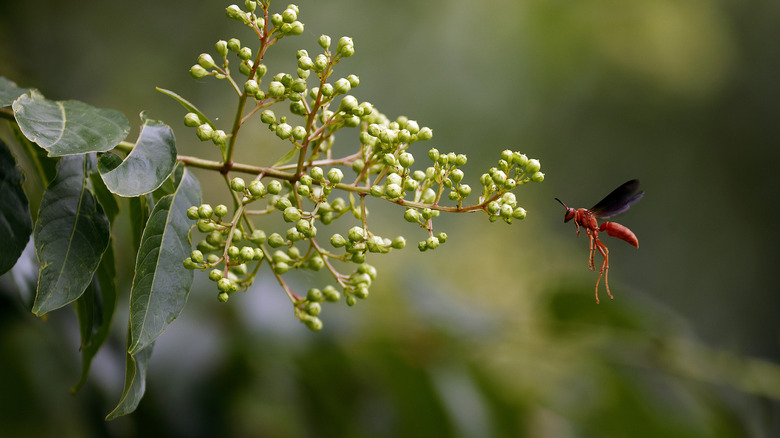
To that end, another sign of a paper wasp nest is whether you see the associated insects nearby. Their coloring can range between different species from reddish-brown to yellow or black, and they all have long legs. As for size, the University of Maryland Extension says that paper wasps are considered "medium-sized" species ranging between 5/8 of an inch to an inch long. Also, while paper wasps will sting when they feel threatened, they are not as aggressive as other types of social wasps.
Should you automatically remove paper wasp nests?
The key question is, once you have accurately identified a paper wasp nest, should you do anything to get rid of it? Paper wasps are inherently beneficial to gardens for natural pest control, as well as the ecosystem at large. However, they can cause issues if they build their nests around common areas around your home, and it's understandable you might be worried about getting stung in the case of accidental encounters.
Any next steps you take after finding a paper wasp near your home really depends on whether its location is possibly dangerous for you and your household. If you decide to treat the problem yourself with commercial insecticides or aerosol sprays, be sure to follow all product instructions carefully and tackle the problem at night when wasps aren't as active. Alternatively, seeing several nests and wasps around your home may require a call to a pest control expert. They may also go over preventive measures with you, including how to repel wasps from wood.
You can also rest knowing that finding an old paper wasp nest isn't anything to worry about once frosty conditions arise. Social wasps do not reuse their nests, with paper wasps included. With the exception of the new queens, the majority of worker paper wasps die each winter. If you see an empty nest in the late autumn or winter with no adult wasps nearby, you may be able to safely remove the entity.