

What To Do If You Find A Paper Wasp Nest Near Your Home
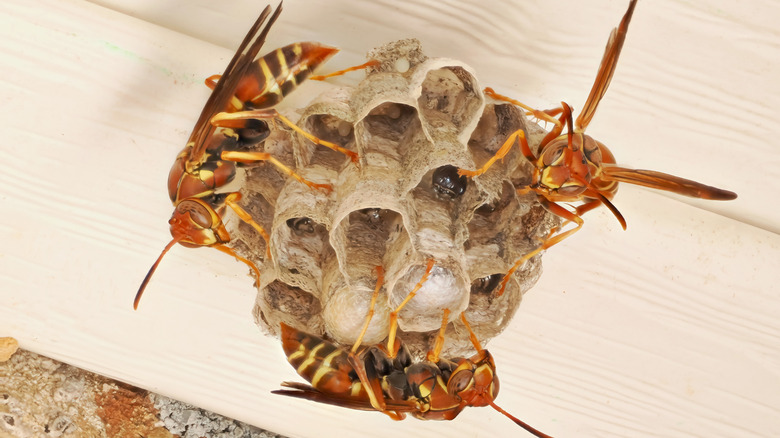
Wasps are essential pollinators, but you likely don't want them near your home. However, treatment depends on the species of wasp and where the nest is, so identifying types of wasp nests is crucial. You may have an idea of what to do if you find a ground wasp nest in your yard, but what if a paper wasp (Polistes spp.) starts building a nest near your home? You can identify a paper wasp nest by its open structure and somewhat curved shape. Paper wasps often build nests near houses or other structures because they offer shelter, so you may spot them under overhangs or on porch roofs.
If the nest is in a place where you can observe it, you might be interested in trying to identify the type of paper wasp living in it, as some are native while others aren't. For example, the European paper wasp (Polistes dominula) is invasive in the U.S. and closely resembles a yellow jacket, while the Northern paper wasp (Polistes fuscatus) is native to the U.S. and is generally darker in color. If the wasps are native and the nest is somewhere out of the way, consider leaving them alone.
However, there are some cases when it's better to remove the nest or even kill the wasps entirely. If you can identify the wasps as an invasive species, then there's no reason to keep it around. Even if you can't identify the wasps, you'll still likely want to clear them out if the nest is in a highly trafficked area or if you or someone close to you is allergic to wasps. In these cases, the wasps are more likely to be a hazard and removing the nest or killing the wasps may be the safer option for you.
How to remove a paper wasp nest
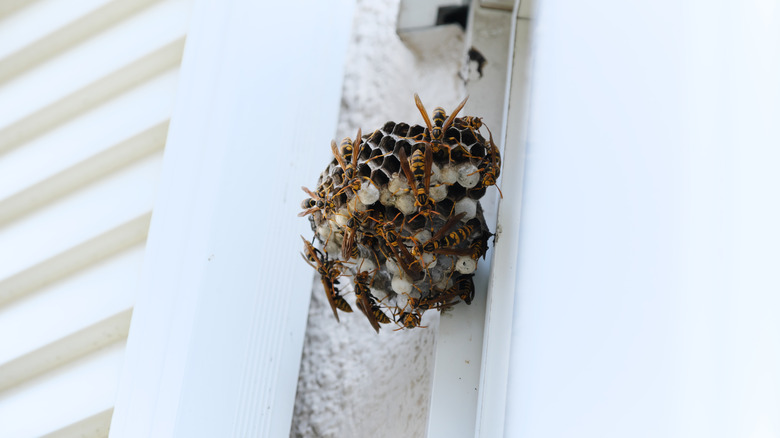
When possible, wait to remove the nest until winter. Most of the paper wasps will die once the weather turns cold, making it safer to handle. However, if you can't wait, try to remove the nest while it is still small. The larger the nest is, the more paper wasps there are and the harder it will be to remove safely. Additionally, if the nest is still small, there may not be any eggs inside yet. Paper wasps are more protective of their nests once eggs have been laid, so removing the nest at this stage is generally safer. It's best to take action at night, when the wasps aren't active. Wear protective clothing and bring a light if the nest is in an area with tripping hazards. Use a red light or one that is covered or dim to avoid alerting the wasps.
If the nest is small, spray it with wasp spray then retreat to a safe distance. Be sure to read the instructions on the spray before using it, and be careful when spraying it in the dark. You don't want to accidentally spray yourself! If the nest is larger than a quarter, you may not want to handle it yourself. At this size, there may be eggs, along with a larger colony. Even when working at night, you'll risk getting stung. Instead, contact a professional for assistance. They'll be able to get rid of the wasps safely. You may also want to hire a professional if you are allergic to wasp stings, since the risk of getting stung carries more danger for you. After removal, surviving wasps may try to rebuild, or a new colony may move in, so consider moving plants that attract wasps further away from your home.