

The Rare '70s Pyrex Casserole Dish You'd Be Thrilled To Find At The Thrift Store

Vintage Pyrex dishes come in a range of shapes — including the dreamy Cinderella bowls and casseroles, basic round mixing bowls, and rectangular space-saver casseroles — and sizes, from one pint up to 4 quarts. The biggest of the big Pyrex, a 4-quart round casserole dish, model number 664, is relatively uncommon. Affectionately nicknamed "Big Bertha" by fans of the glassware brand, the large casserole dish wasn't in production for very long. However, it was produced in some of Pyrex's longer-running patterns, such as Spring Blossom and Butterfly Gold.
Big Bertha also found herself modeling some rare and mysterious patterns, such as Polynesian. Not much is known about the Hawaiian-inspired print, but it's largely believed to have been a test piece that never saw the light of production day. However, it seems that a few Corning employees snuck a Polynesian Big Bertha or two home, and now the dishes are commanding top dollar when found, somewhere between $3,500 and $4,000. Meanwhile, Big Berthas in other, more common patterns typically sell in the neighborhood of $200.
On the hunt for Pyrex Polynesian
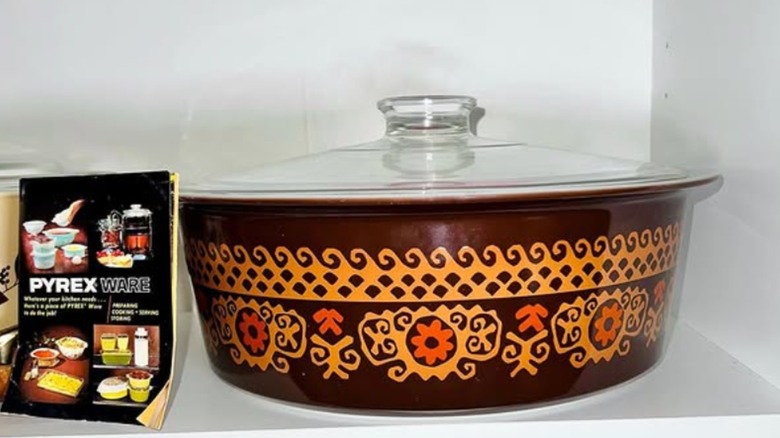
While there may not be official records of the Polynesian pattern floating around Corning headquarters — in fact, Polynesian isn't an official name — you can play Pyrex sleuth and figure out a few details about the dish, should you get your hands on it. First, pay attention to the pattern's colors, as there are actually two versions of Polynesian out there. The more common one has an opal glass background with a rust or burnt orange pattern. The even rarer colorway has a brown background and a design printed in red and orange. For both colorways, you can count the number of pieces that exist on one hand — making it one of the rarest Pyrex patterns out there.
The pattern's design looks like ocean waves above a row of abstract flowers. Flip the piece over, and the backstamp will give you a clue as to when the pattern was created. Collectors who have gotten their hands on the Polynesian pattern note that the backstamp lists the casserole's volume in US and metric amounts — an indication that the piece was produced sometime after the mid-1970s, when Corning started adding metric measurements to its backstamps.
To be honest, the Polynesian pattern is rare enough that you're unlikely to stumble across it at your average thrift store. You'll have to look beyond the thrift store to find the rare Pyrex gem — heading to estate sales and scouring online auction sites. But, should you come across it, and for a price that's less than four figures, it'll make your day.