

Skip The Bench Grinder: Sharpen Your Landscape Edger Fast With A Portable Alternative
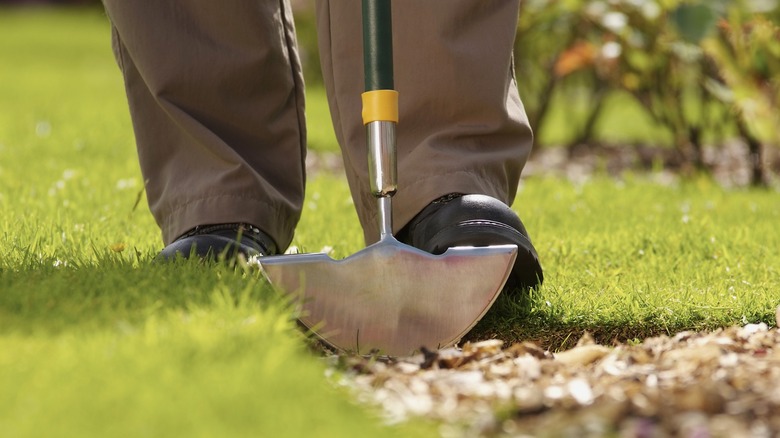
Whether it's around a garden bed, along a walkway, or along a driveway, a clean edge helps keep your lawn looking beautiful. It stops grass from spreading where you don't want it to go, improves drainage, and makes maintenance, including mowing, easier. You can buy an expensive tool to edge your lawn, but this is one job for which a cheaper tool that's already in your shed, like a hand edger, works just as well if you keep it sharp. You can easily do this with an angle grinder, as garden tool expert donnyboy73 demonstrates on YouTube.
A manual edging tool typically has a semi-circular blade, because this shape helps it penetrate the ground and makes edging easier. The shape of the blade doesn't matter much to an angle grinder, though, and it will happily sharpen semicircular and straight blades with no problem. It will also sharpen your shovels, shears, and even your lawn mower blade.
Because an angle grinder wears down metal so quickly, it's tempting to sharpen garden tools to a razor's edge when you use one, but it's wise to avoid this, especially with an edger. A sharp blade may cut grass more cleanly, but it chips more easily when it encounters rocks and coarse soil, and that means you have to sharpen it more frequently. Generally, you're aiming for the sharpness of a dinner knife, and that seldom takes more than a few quick passes with an angle grinder.
How to sharpen your edger with an angle grinder
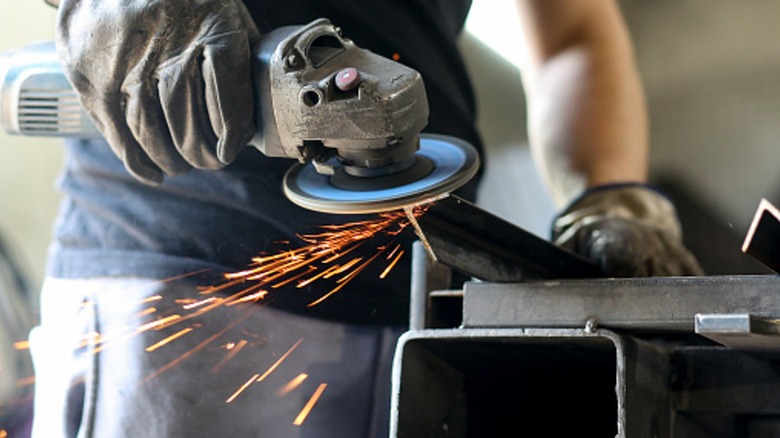
The first thing you need to do is get out your angle grinder and a grinding disc. You may need to change the blade on your angle grinder if it looks worn. If you don't already own an angle grinder, and you're going to buy one, go for a 4-inch cordless model. It's lightweight, and you can use it anywhere in the yard without having to be near an electrical outlet or plug in an extension cord. When choosing a grinding disc, go for a flap disc, which is easier to control than a diamond-grit grinding disc. You'll also need goggles and gloves to protect your eyes and hands from sparks and flying shards of metal.
When working in the shop, it's always a good idea to support the tool you're sharpening in a vise for stability, but out in the field, you can simply hold the edger in one hand and run the grinder over the blade with the other. Make one or two passes over the blade with the grinder, turn the edger over, and repeat on the other side, then feel the blade. If it doesn't feel sharp enough, make one or two more passes, but don't overdo it. Remember, it should be dinner knife sharp.
After grinding, you may notice a few nicks and gouges on the blade. Rather than trying to remove these with the grinder and risk over-sharpening the blade, use a flat file. For best results, file only on the push stroke rather than using a back-and-forth motion.