

Wolf Spiders Don't Spin Spider Webs: Here's What You're Actually Seeing
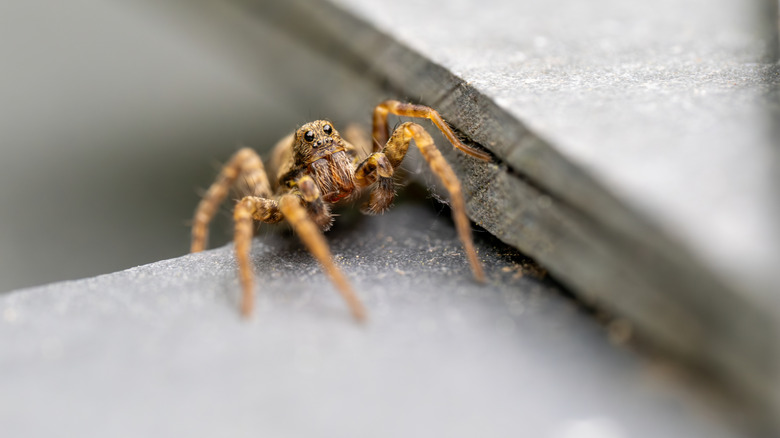
There's nothing quite like the creepy-crawly feeling of walking through a spider web! Yes, plenty of spiders do spin webs to catch their prey, but not the wolf spider. Instead, these athletic arachnids lie in wait for their dinner. When it passes by, they chase it down to enjoy their meal of cockroaches, beetles, and flies. However, wolf spiders do leave behind silk lines on occasion. This is more of a social behavior, though. In particular, male spiders will follow the line of a female spider back to her hiding spot to make more wolf spiders. Typically, at least 100 at a time. Luckily, wolf spiders are not dangerous to humans. While they can and do bite, the risks are small: An allergic reaction in rare cases, or some itchiness at the bite site.
There are more than 238 species of wolf spiders in the United States, making them one of the most common spiders you'll find lurking in and around your home. They are not too particular about where they live. You'll find them under rocks and inside logs, among leaves, and, sometimes, in the dark back corner of your pantry (don't ask us how we found this out). That said, wolf spiders tend to be nocturnal, so you are most likely to discover their silk communication lines in the morning. Some species also line their tunnels with silk. You can wipe away these wisps, but the spiders will simply make more. So, the best strategy for keeping your home free from wolf spider lines is prevention. This can be done by checking for holes or gaps near windows and doors, or using scents like citrus, peppermint, and eucalyptus.
Common webs found at home
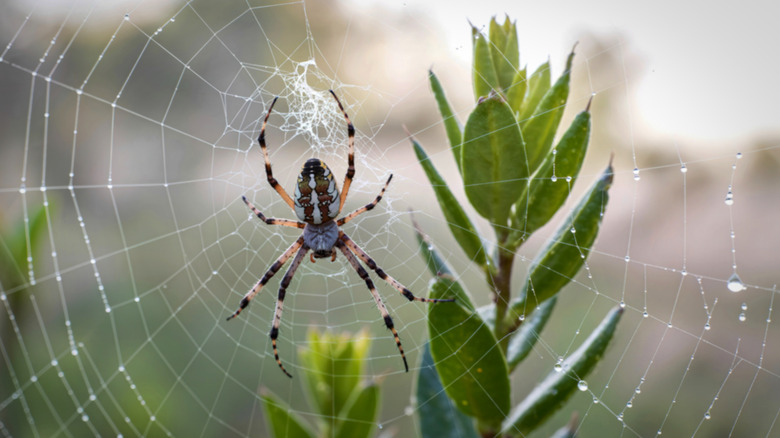
While it's totally possible that you really are seeing the wispy threads created by a wolf spider, it's more likely that another arachnid left behind its web. For example, the barn funnel weaver spider is quite common throughout the United States. They weave messy-looking webs with a built-in hideaway where they wait for their dinner to wander by. You're likely to see these webs outside near sheds and garages.
You might also see the most classic spider webs, like the ones of of "Charlotte's Web." These are built by orb-weaver spiders. There are multiple species of orb-weavers, but all have pretty symmetrical, round-ish webs. The silk is sticky, so bugs get tangled up it in and then the spider can eat. Finally, cobweb spiders build those wispy webs that are perfect for Halloween. Black widow spiders belong to this group. They spin irregularly-shaped tangle webs, which are easy to recognize if you do find a black widow in your yard.
Regardless of the type of web, if you do find an unwanted arachnid, knowing how to get rid of spiders is easy. Just use a cup and a sheet of paper or cloth to scoop it up and take it back outside. Do use some caution if you are unsure if the spider is dangerous. You can then just sweep up or wipe away the lines left behind. You don't need special precautions, as the web material is harmless.