

Borax Vs. Boric Acid: What's The Difference?
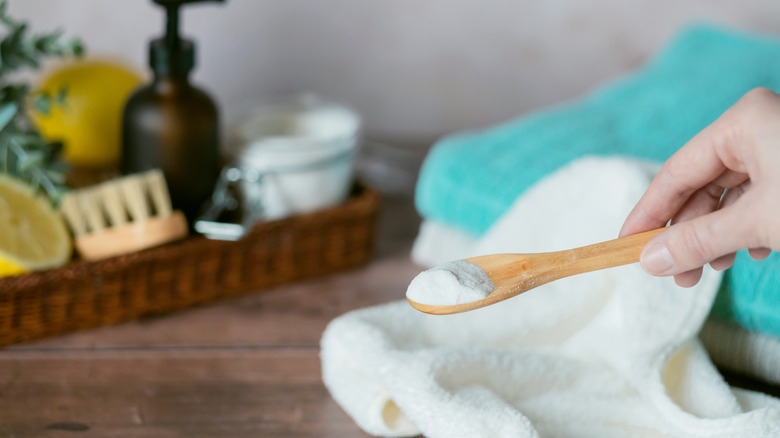
You go to take a stain out of your clothes and grab the borax. Or, should you grab the boric acid? It's easy to mix the two substances up for household cleaning tasks when they sound similar in name and even look alike. Borax and boric acid both contain the element boron, but they aren't the same thing. Borax has been a common household cleaning aid since large deposits were discovered in Death Valley, California, in 1881. Since then, people have used it to wash clothes and to clean, disinfect, and deodorize around the house. You can even easily kill weeds with borax. Boric acid, on the other hand, has a longer history that extends as far back as ancient Greece. Aside from cleaning, it has many other applications in manufacturing and medicine.
Borax and boric acid both occur naturally, but they have significantly different chemical properties. Borax (sodium tetraborate or sodium borate) is a salt that comes primarily from mines in Turkey and California with a pH of around 9.1, making it an alkaline substance. The natural form of boric acid (hydrogen borate) is sassolite, which is found in volcanoes, seawater, and even in fruit. It's a weaker acid, with a pH of around 6. The differences in chemical composition and acidity have a bearing on their usefulness.
These two compounds also differ in how they are produced. Whereas it's possible to harvest small amounts of boric acid from natural sources, as people have been doing for centuries, manufacturers produce commercial quantities by combining borax — which is easier to mine — with other compounds. Once you have a large quantity of borax, you have a potential source of boric acid, but it doesn't work the other way around.
Both borax and boric acid are useful, but in different ways
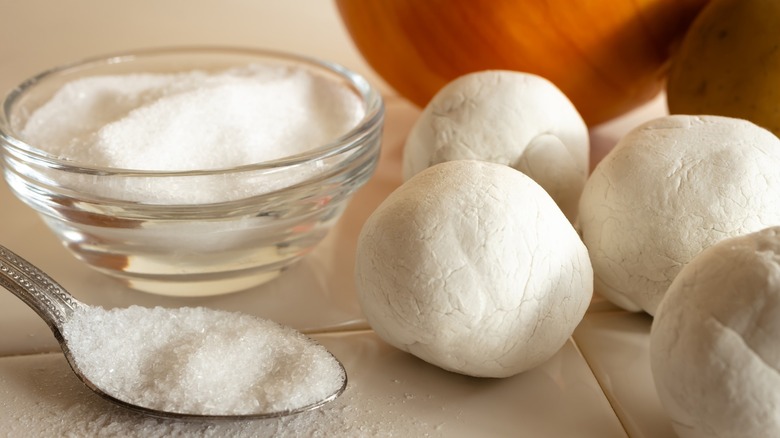
The high alkalinity of borax makes it a good emulsifier that helps dissolve stains, and it also softens hard water to make detergents more effective, which is why people use it as a laundry detergent additive. Borax is safe to use on most household surfaces, and effectively removes tough stains from hard water, grease, and rust. It also kills mold and mildew. You can increase its effectiveness by mixing it with other cleaning agents, including dish soap, lemon juice, and castile soap.
Because it's acidic, boric acid doesn't work as an emulsifier. However, it's a good disinfectant, which is why people have traditionally used it for cleaning. This property is also useful in the world of cosmetics and personal hygiene, and medical professionals use boric acid solutions to relieve yeast infections, diaper rash, insect bites, sunburn, and to disinfect minor wounds. Boric acid also boosts chlorine when added to swimming pool water, and it's an effective fire retardant.
Both boric acid and borax can eliminate insects, but boric acid is generally more effective. This is largely due to how it's produced. A common method for making boric acid is to combine borax with sulfuric acid in a centrifuge, which results in a powder much finer than borax. Because boric acid granules are smaller and easier to handle, insects are more likely to ingest them when used as bait.