

Skip Paint: Give Your Dated Coffee Table A Stunning White Oak Upgrade
We may receive a commission on purchases made from links.
Finishes on solid wood furniture flow in and out of fashion, much like how my righteous mullet and Fu Manchu looked totally rad as I worked in my dad's woodshop back in the day, but just would not hit the same today (or would it?). As a professional woodworker with decades of experience, I've had to navigate all kinds of changing styles and emergent trends. One secret I've learned in my efforts to keep my process and projects up to date is that the difference between a dated coffee table and a beautiful coffee table could simply be the finish. But while a coat of paint is an obvious and straightforward solution, wood's texture offers the potential for even more unique effects. Recently, a popular option embraced by influencers is the warmth and sophistication of white oak. And when you're dealing with an out-of-fashion table in need of an upgrade (or just trying to make the wood look less orange), opting for this timeless look is a pleasantly simple DIY fix.
Now, about that "white oak" look. As a woodworker, I have used white oak for years and years — in fact, it is one of my favorite hardwoods to use when making furniture. You'll find white oak flooring, cabinets, and furniture everywhere. What many of these influencers are talking about when they present a "white oak" look isn't my favorite hardwood, but rather a light brown hue with whiter highlights. (It's a brownish stain applied with a white stain following or mixed into it, no paint needed.) You can use this white oak look on coffee tables made from almost any common wood variety — oak, pine, birch, maple ... you name it.
Achieving that white oak look to update your coffee table
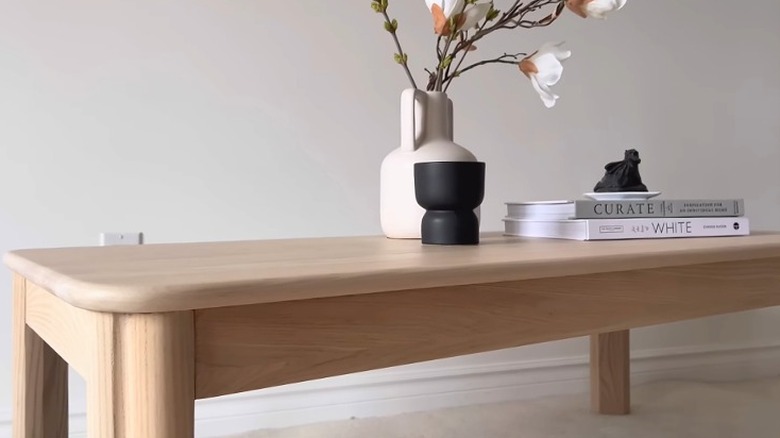
That "there is nothing new under the sun" may be attributed to King Solomon, but the saying "I've seen this finish before" almost certainly belongs to yours truly. Adding bright white highlights to a furniture's finish is not a novel idea. The version I see online is a more subtle example than a traditional "pickled finish" (yep, a pickled finish — white, not green). Look up how to whitewash wood, and you'll find many examples similar to the technique, a modern "white oak" look that is relatively easy to achieve.
@auroradesigngrp let's see how much you know about white oak door • which is which??? #whiteoak #customcabinets #customcabinets #cabinetdesign
Start by stripping or sanding away the existing finish and filling cracks or holes with wood filler. With any finishing task, surface preparation is critical. You'll want to sand the surface up to 220-grit sandpaper, producing a smooth, uniform surface to accept the stain. If the wood is birch, maple, cherry, pine, or a type you simply don't know, use a pre-stain like Varathane Wood Conditioner to avoid blotching, and follow up with a brown oil stain of some sort. The colors I've seen used are medium-brown hues, but the choice is yours. After that, be sure to allow the stain ample time to cure.
Next, you'll use a white oil stain (probably called "pickling stain" at the store), thinned with mineral spirits. In my experience, starting with a ratio of one part stain to three parts thinner is the way to go. All you need to do is apply the mixture with a cloth or brush, and then wipe it off. If the white highlights are too subtle, you can add more stain to the mixture before repeating the application. When you like the look, it's time to let it dry. Follow up with three thin coats of water-borne polyurethane — I use a synthetic painting pad for this. Congratulations, you've upgraded to the trendy white oak look without breaking your budget!