

Mold Vs. Mildew: Is There A Difference?
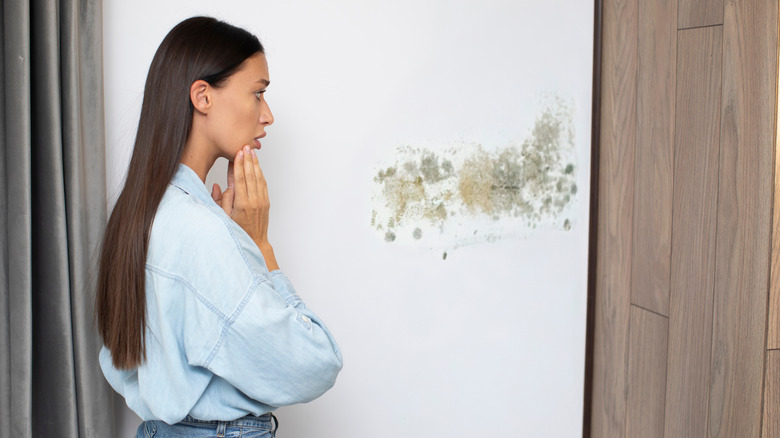
I wager that, for many of you, your first experience with mold or mildew occurred as an adult, when you noticed a funny smell coming from under your sink. For me, my dad was a professional air quality consultant. I grew up looking at sealed Petri dishes filled with fuzzy, colorful spores that had grown from air samples my dad had taken for clients. So, I learned early on that even though they are both types of fungi, the differences between mold and mildew lie in their appearance, smell, and how they grow.
The first way to tell the difference between mold and mildew is by sight. Mold growth in your home can be caused by leaks, poor ventilation, high humidity, dampness, and poor insulation. In appearance, common household molds like Cladosporium and various Aspergillus appear as fuzzy, slightly bulbous spores in a range of colors like blue, green, gray, or white. Toxic black mold is a blackish-green color with a texture that hovers between slimy and fuzzy. Mildew likes to grow in identical conditions, and most commonly appears as flat and powdery grey, white, or yellow spores.
Another differentiator between mold and mildew is the smell. If the area you're examining has a musty stench, that's mold. If the scent is milder and has a hint of dampness, that's mildew. Don't go looking for mold or mildew via smell, because inhalation can cause potentially severe reactions.
Mildew is easier to clean than mold, and less dangerous
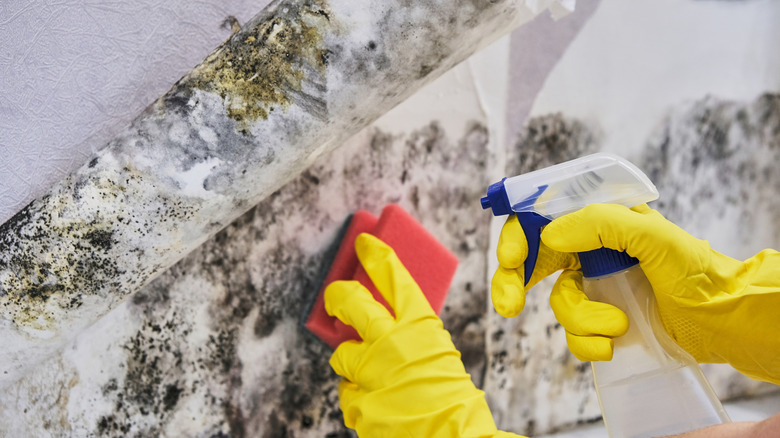
While both mold and mildew thrive in moist, poorly ventilated environments, the way they grow is distinctly different. Mildew will grow flat and remain on the surface of an object. You'll often find it in laundry rooms, on your shower walls, and on your window sills. Thankfully, getting rid of mildew is pretty easy. Since mildew grows on the surface of an object, it is much easier to remove. In fact, you can clean mildew off of a painted wall with a simple DIY cleaner.
The tricky thing about mold is that it will grow deeply into the pores of materials like wood, drywall, and even concrete. It also loves the dark, which is why you'll most often find it behind walls, underneath sinks, or in your basement. Because of its clingy nature, it's much more difficult to get rid of since you can't just wipe it off the surface. You can treat small patches of mold with a baking soda solution and elbow grease, or just throw the moldy items away. However, if the growth is severe enough, you will need professional remediation.
Then there are the health concerns. Exposure to mildew will very often only cause mild reactions like an itchy throat or a headache. Prolonged exposure to mold can cause continual respiratory issues, skin irritation, nosebleeds, and chronic migraines. So, if you do find mold growing in your home, it's best to address it immediately.