

Why Do Cinder Blocks Have Holes?
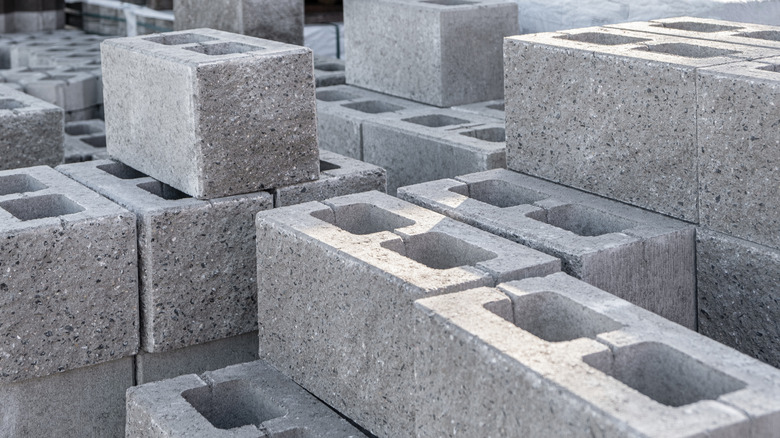
Cinder blocks are a versatile construction material. But have you ever wondered why concrete blocks have holes? If your immediate answer is "To make them weigh less," you're right. Cinder blocks are intentionally designed with holes to make them lighter. This weight reduction has the added benefit of making them easily transportable, which in turn makes installation more efficient. However, that's not the only reason cinder blocks are designed with holes. With a material so versatile that it can be used to make everything from a house foundation to a stylish backyard bar and planter to a durable DIY retaining wall, it's fascinating to learn how they are made and why they have holes.
Cinder blocks are constructed from a durable mixture of Portland cement and aggregates. The mixture gets poured into a mold and pressed together to form what we recognize as a cinder block. The two square holes are divided by a concrete core, which adds stability and strength. Once set in place, cinder block holes can be filled with poured concrete to make them even sturdier. This is necessary if you are building a load-bearing wall like a basement foundation.
Another reason the cinder blocks have holes is that they make it much easier to run or connect plumbing or electrical lines. The hollow sections provide space for pipes or wires. Even if you drill into the cinder block to run piping, you won't damage its overall structural integrity.
The holes in cinder blocks serve other purposes, too. They increase the block's soundproofing qualities. The holes reduce noise infiltration from other rooms or outdoors.
Besides reducing weight, cinder block holes have insulating qualities
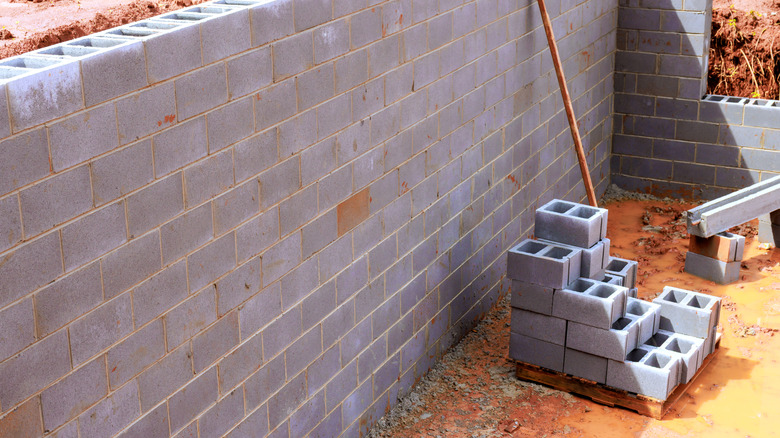
Perhaps the most important reason for holes in cinder blocks is to improve insulation in home construction. Filled cinder block walls provide excellent insulation. Cinder blocks have similar conductivity to a solid concrete wall. A solid concrete wall is a good insulator because it can store heat. As such, it will help keep a space warm by slowly releasing heat throughout the day.
Cinder blocks have an R-value between 1.11 and 1.89 because of the holes in the blocks. R-value refers to a material's resistance to heat flow. The R-value of a cinder block is higher than that of solid concrete, which has an R-value of 0.53 per cubic foot. It is also higher than wood frame's R-value of 0.81. The cinder block holes retain air, increasing their thermal resistance. Cinder blocks help maintain indoor temperatures thanks to this feature.
Does adding insulation to fill the holes increase a cinder block's R-value? Not necessarily, unless the wall remains uncovered. If you do leave cinder block walls uncovered, spray foam insulation or loose masonry insulation can be used to fill the holes and increase R-value. If you're finishing an interior space, use rigid foam boards as insulation and a vapor barrier before installing any drywall. This is another great way to increase the wall's overall R-value and maintain a more even indoor temperature.