

Pyrex Isn't The Only Antique Dishware Brand Worth Hunting For At The Thrift Store

Let's face it, as much as you love Pyrex, it's getting a little tricky to track down at your local thrift store. The antique glassware brand has become known for its colorful bowls and casseroles, and demand for rare or promotional patterns, like orange Butterprint mixing bowls, means individual pieces can easily sell for hundreds of dollars. But amid all the Pyrex hype, maybe you're looking to mix things up a bit.
Luckily, there's another antique dishware brand to set your thrifting sights on — Mason's. Although the styles and materials used are considerably different, Mason's has a lot in common with Pyrex. Both are antique brands — Pyrex first produced its glassware for use in the kitchen in 1915, and Mason's developed its patent ironstone china in 1813. Both used innovative materials in their products. For Pyrex, it was borosilicate glass. For Mason's, it was ironstone, which is sturdier than porcelain, a material often used for fine dinnerware.
Ironstone is a chip-resistant, white-bodied earthenware. Developed by Charles James Mason, ironstone looks like porcelain but is much more resilient and better suited for everyday meals. In addition to the use of ironstone, Mason's Patent Ironstone China had decorations attached to the dinnerware using decals, rather than being painted on. Just as Pyrex was originally affordable and intended for the general public, Mason's China was meant to be a more affordable option. Today, though, pieces easily sell for thousands of dollars, meaning if you find one at your thrift store for a steal, it's a reason to celebrate.
Identifying authentic Mason's Patent Ironstone China
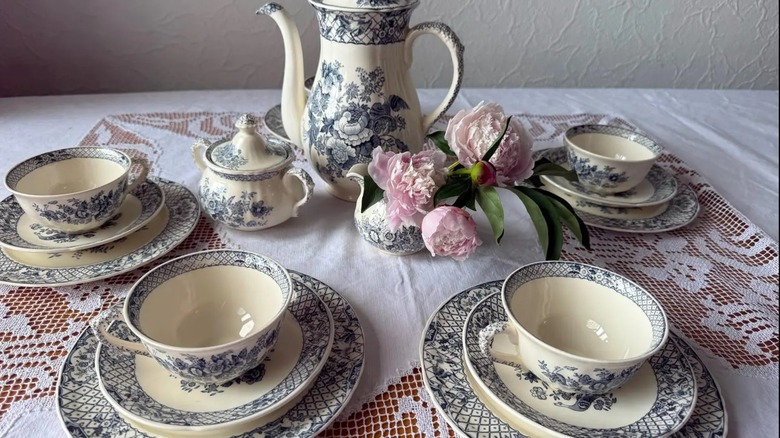
You're browsing your local thrift store, and you spot a blue and white plate. Could it be an authentic Mason's piece? There are a few ways to tell. One is to examine the quality of the piece. The decoration will be a decal, but it should be a sturdy, well-adhered decal. The plate should also feel sturdy and heavier than what you'd expect for porcelain (since it's not made from porcelain). The style may imitate blue-and-white Chinese porcelain or have an intricate pattern, such as a water lily, on it.
Plenty of fake Mason's pieces exist, as do reproductions, which, while attractive, don't have the same value as the authentic, 200- or 100-plus-year-old pieces. Another way to tell if the China is valuable is to look at the mark on the backside. The design of the mark can clue you in to when the piece was made and whether it's legitimate. The earliest pieces may have an impressed mark that simply reads "Mason's Patent Ironstone China." In some cases, an early piece, pre-1820, may have a decal mark.
Marks got a little fancier starting in about 1820. Pieces from the 1820s should have a mark with a crown, with MASON'S in all capitals printed above it. Beneath the crown, it should read "Patent Ironstone China," often in a banner. After 1920, the pattern name was usually included in the mark, and after 1940, the brand included "Guaranteed Permanent and Acid-Resisting Colors."