

If You Like Mid-Century Modern Decor, Here's A Thrift Store Find For Lighting

When atomic age design lifted off from the mid-century modern aesthetic, it introduced a layer of shapes, colors, and materials that complemented the underlying MCM ethos. But atomic lighting was a bit of a moonshot. Chandeliers were reimagined as exploding atoms or the rays of a star, frozen in time (you might recognize the style from the starburst clocks that you'd also love to find at a thrift store). Pendant lights became sculptures of a moon in cross section, revealing concentric spheres of light. Table lamps might have suggested a mushroom but, everyone knew, really whispered of mushroom clouds. Atomic lighting was a moonshot because there was every reason to believe it wouldn't work, but it did. And that's why picking up one of these often whacky, occasionally sublime fixtures in a thrift store is also a bit of a moonshot.
These atomic lighting fixtures looked like spheres with radiating arms, or flying saucers, or solar system models, or a molecule that's overly excited or distressed. Sometimes there would be hallmark boomerang shapes or other markers of space age design. These were statement pieces in a medium-is-the-message kind of way. Earlier statement lighting might have suggested grandiosity or wealth — these fixtures simply insisted that you not look away.
Perhaps atomic lighting has reentered our orbit because it was the product of an era of post-war hope. Or maybe it was the "futuristic" materials, vivid colors, and whimsical design. Or maybe it's the appeal of retro-futurism ... that an object can be at once vintage and futuristic. Whatever the case, they are certainly desirable, occasionally findable in thrift stores, and often quite valuable.
Pendant lights and chandeliers
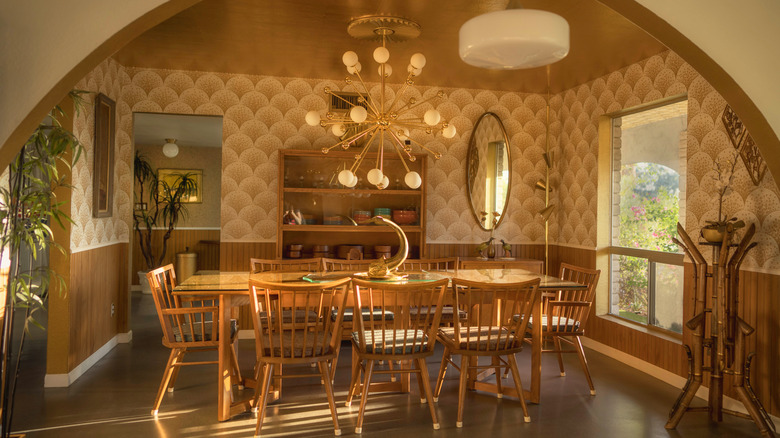
The quintessential example of atomic lighting might be the Sputnik chandelier, and it's certainly the key fixture to keep an eye out for at thrift stores, estate sales, and the like. The Sputnik chandelier is spectacular, and it defies description not because of its intricacy or originality but because it's not a single thing. There are many pendant lights and chandeliers dubbed "Sputnik," and it's easy to see how they inherited their central-globe-and-radiating-arms design from the 1957 Soviet Sputnik satellite with its central sphere and four radio antenna prongs. The trouble is that the designer of the original Sputnik chandelier, Gino Sarfatti, designed it years before the Sputnik 1 satellite made history by becoming our planet's first artificial satellite in 1957. Sarfatti himself called his model 2003 ceiling light "Fireworks," and it's not clear to what extent it was even inspired by the space age that was in its infancy at the time.
All of this turns out to be good news for thrifters and collectors alike, because an untold number of fixtures came to be known as Sputnik lights. "Sputnik" represented atomic lighting so well that it became a sort of category of pendant lights, chandeliers, and flush-mount ceiling lights. Other iconic hanging fixtures included the Stilnovo saucer lamp (which looks like a flying saucer, or perhaps a lotus seed head); Verner Panton creations like his Moon and VP Globe pendant lamps; and a plethora of often-kitschy bug-eye lamps. All of these pendants and chandeliers share more of a vibe than common design elements.
Table, desk, wall-mounted, and floor lamps
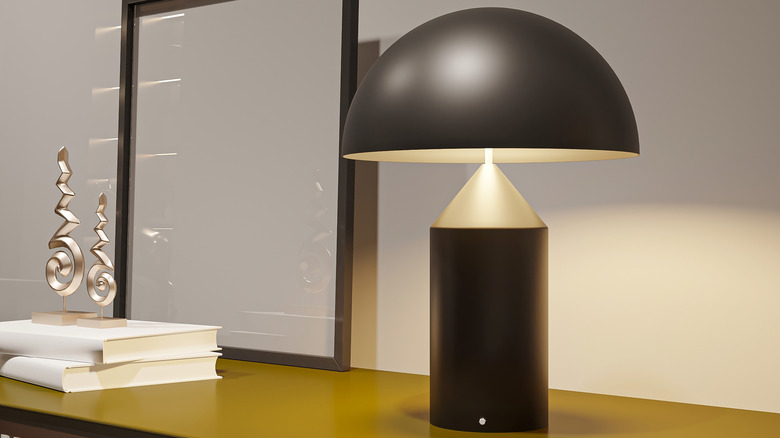
The atomic lighting movement also reached the table, desk, and floor lamps of the era. Space age standing lamps might have been even less cohesive than hanging lights, but this genre has its icons as well, like the similar mushroom shapes of Giancarlo Mattioli's 1964 Artemide Nesso table lamp and Verner Panton's 1971 Panthella floor lamp. The Guzzini Clan and Magistretti Eclisse table lamps could also be siblings ... one with a head in the clouds, the other staring resolutely forward.
Vico Magistretti's all-metal Atollo lamp looks machined on an alien lathe, while Joe Colombo's famous KD29 lamp looks like an anti-gravity-fed coffee maker. Colombo's eponymous, Spider, and Coupé lamp series were avant-garde while boasting a rather utilitarian set of features. Many lighting companies and lesser designers attached themselves to the trend, and these mass-produced, often more kitschy fixtures are likely more common in thrift stores today. The standing lamp category seems far better represented in today's Reddit and Instagram "thrift-store find" posts. And if such a find isn't in the cards for you, the trend ensures that space age lighting is well-represented among the most stylish lamps you can find on Amazon.
Perhaps predictably, the U.S. Apollo space missions marked a fulfillment of the Space Age's promise and the fading of space age design. But the nostalgia for atomic lighting design remains strong and is surely kept alive in part by the promise and prosperity of the era. Or maybe you just like 'em ... and, besides, these fixtures are a natural fit for once-ubiquitous atomic ranch homes, if you're lucky enough to have one.