

Ditch Traditional Concrete Driveways For A More Unique Alternative You'll Love
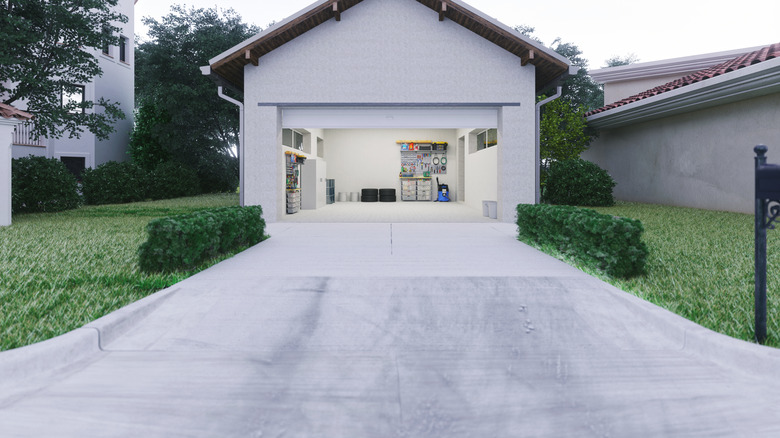
Traditional concrete driveways have many redeeming qualities. Most importantly, they are durable, easily standing up to daily use over time. They are perfect for warm climates where they reflect heat and don't get soft on extremely hot days, like asphalt driveways do. But one word that fails to come to mind when you think of a concrete driveway is "attractive." They are often bland and undistinguished, so much so that some folks want to ditch their concrete driveway entirely.
Luckily, they don't have to be. You can add color and patterns to a concrete driveway. Concrete can be stained, and you can even add border patterns with their own distinct stained color. Now, you may be wondering if you can successfully do this as a DIY project. The answer is yes, if you follow the necessary step-by-step process.
There are basically two types of concrete stain, acid-based and water-based. Acid-based products react chemically with the concrete to create a variegated look that some find reminiscent of the color patterns in natural stone. It's often used in stained concrete floors. Water-based stains penetrate the concrete, but don't react chemically with the surface. There is a wide variety of colors available, and they have low VOCs and are not dangerous to handle. Additionally, there are stencils available to allow you to do things with the stain, like creating a colored border with a geometric pattern on your driveway.
What to know when staining your driveway

Stain can be applied to existing concrete or as it is being installed. If applying when the concrete is poured, it is most effectively done by professionals as they do the initial installation. Differing sections can be easily colored as they are sequentially poured.
To stain an existing surface, start by cleaning it completely. Sweep and blow away any dirt and debris. Follow that up with a power washer using an appropriate detergent. Concrete is porous, so after pressure washing, allow it to dry for at least 24 hours. Take the time to clear the dirt away at the edges of the concrete pad and clean them as well. Before applying, make sure you have a paintbrush and roller. When it comes to applying the stain, use a paintbrush to cut in, carefully applying the color around the perimeter of an area without getting it on adjacent walls, etc., around each section. Then, apply the stain with a roller to fill in the remaining area.
Using stencils to create a border pattern is reasonably easy to do, but it does require attention to detail. Apply sufficient stain to color the concrete, but not so much as to allow it to flow outside the constrictions of the stencil. When you are done applying your stain, whether acid- or water-based, you need to apply a sealer to protect the concrete's surface and help retain the color of the stain.